
Quick answer: For most borrowers carrying a 580–620 FICO score, a full-service mortgage broker with wholesale lender access delivers the highest approval probability and the broadest rate competition — making it the professionally managed path most worth the cost. The core trade-off is this: broker compensation (typically 1–2% of the loan amount, embedded in your rate) costs real money over the loan term, while a true DIY approach eliminates that layer but demands significant research time and carries a meaningful risk of application errors that can sink an already-borderline credit file. Borrowers who are at or near 620 FICO, hold an existing FHA loan eligible for streamline refinancing, or have straightforward W-2 income and clean documentation may find an online lender platform or the HUD counselor hybrid route equally effective at lower total friction cost.
How We Evaluate & Compare Options
This comparison is grounded in published lender guidelines, CFPB consumer research on mortgage shopping, HUD program documentation for FHA and housing counseling, and publicly disclosed mortgage industry data on closing costs and timelines — not proprietary testing or claims of firsthand loan execution. Four criteria drive the evaluation for a 580–620 credit score borrower specifically:
- Approval likelihood: FHA's published minimum FICO for a 3.5% down (or equivalent equity) refinance is 580. Fannie Mae and Freddie Mac conventional guidelines require a minimum 620 FICO. However, lender overlays — credit minimums that individual lenders apply above the agency floor — mean a borrower at 593 can be declined by an institution that technically offers FHA loans. Who presents your file and to which lender matters as much as the file itself.
- All-in cost: CFPB consumer resources document that refinance closing costs typically range from approximately 2–6% of the loan amount, varying by state, loan size, and lender. This includes origination fees, third-party charges (title, settlement, appraisal), and — where applicable — broker compensation. All four of these inputs differ by channel.
- Time to close: Industry origination data consistently shows median times to close ranging from roughly 21 to 50+ days depending on loan type, channel, and file complexity. Each day without a lower rate is a forgone monthly savings; timeline risk is not trivial for borrowers near a rate-lock expiration.
- Documentation error risk: A single unexplained bank deposit, employment gap, or collections account on a borderline credit file can move a file from conditional approval to denial. This criterion measures how much expert guidance each path provides before the file reaches an underwriter.
At-a-Glance Comparison: Five Refinancing Paths for 580–620 Borrowers
| Approach | Typical Added Cost | Lender Access for 580–620 FICO | Est. Time to Close | Documentation Help | Best For |
|---|---|---|---|---|---|
| Full-Service Mortgage Broker | 1–2% of loan (lender-paid compensation priced into rate, or disclosed borrower-paid origination fee) | Broad — access to 20–50+ wholesale lenders including FHA-approved and non-QM options that honor the 580 floor | 30–45 days (typical) | High — broker prepares, packages, and submits the file on your behalf | Borrowers at 580–599 FICO; complex income profiles; first-time refinancers unfamiliar with process |
| Retail Bank or Credit Union Loan Officer | No broker layer; lender's internal margin applies; relationship pricing possible at 610–620 | Narrow — single institution's product set; overlays frequently require 620+ even on FHA products | 30–45 days | Moderate — LO guides the process but institution's guidelines are fixed and non-negotiable | Existing customers with 610–620 FICO, strong banking relationship, and single-lender profile |
| Online Lender Platform (major direct lender or fintech) | No broker layer; lender margin varies; origination fees often lower than retail channel | Moderate — one lender with wide product menu; FHA options commonly available; advertised floors may carry hidden overlays | 21–35 days (digital workflow) | Low-to-moderate — automated guidance with human escalation available; less flexible for edge cases | Tech-comfortable borrowers with 600–620 FICO, W-2 income, and clean, documentable financial history |
| True DIY — Independent Rate Shopping | No intermediary fee; significant borrower time cost; risk of relocking at worse rates if application errors cause delays | Varies entirely by borrower research effort and knowledge of which FHA-approved lenders honor the 580 floor | 30–60 days (longer when initial applications require correction and resubmission) | None — borrower is solely responsible for file accuracy and completeness before submission | Financially sophisticated borrowers with 615–620 FICO, research capacity, and stable, simple income |
| HUD Counselor + Self-Directed Hybrid | Free HUD counseling through nonprofit agencies (some agencies charge up to $50–125 per session); no broker layer on execution | Counselor educates on options and reviews offers for fairness; does not shop or negotiate rates directly | 45–60 days (counseling session adds preparation time before application) | Moderate — counselor reviews documents, explains Loan Estimate line items, and flags predatory terms; borrower executes | Borrowers who need unbiased education first; 580–600 FICO facing unsolicited high-cost offers; first-time refinancers in distress |
Compared Options
Full-Service Mortgage Broker: The Highest-Leverage Professional Path
A licensed mortgage broker acts as your agent through the entire refinance process: they pull your credit with a single hard inquiry, prepare and package your file, and submit it to multiple wholesale lenders simultaneously. For 580–620 FICO borrowers, this wholesale access is the single largest practical advantage over every other channel. Retail banks and credit unions commonly apply lender overlays of 620 or even 640 minimum FICO on FHA products — meaning a borrower at 593 will be declined at institutions that technically offer FHA-backed loans. Brokers who specialize in near-prime borrowers have direct relationships with wholesale lenders who honor FHA's published 580 floor without overlay, and they know which investors accept specific compensating factors (strong reserves, low DTI, long employment tenure) that can make a borderline file approvable.
When considering professional vs diy mortgage refinancing comparison, you should understand all available options.
Cost reality: Under the Federal Reserve's Regulation Z Loan Officer Compensation rule, brokers cannot be paid by both the lender and the borrower on the same transaction. Most brokers use lender-paid compensation — typically disclosed as 1–2% of the loan amount — which is priced into the interest rate the wholesale lender offers rather than appearing as a cash line item. The rate you receive may be 0.125–0.25% above what the wholesale channel offers without that margin, but that premium is frequently narrower than the rate difference between a 580-approving lender and the lowest rate available only to 620+ borrowers. Compare total cost over your expected holding period, not the rate in isolation.
Pros: Maximum lender panel and approval-path options; experienced file preparation reduces denial risk; competitive rate shopping across multiple lenders simultaneously; single dedicated point of contact through closing.
Cons: Lender-paid compensation adds to the blended lifetime cost; broker quality and wholesale lender panel vary significantly by state and specialization; requires borrower vetting of the broker's near-prime experience.
Meaningful alternative: If your FICO is at 618–620, a direct bank application or online lender may offer comparable approval odds without the compensation layer — particularly if your income documentation is clean and your DTI is under 43%.
Not sure which lenders will actually approve your score? Get a free rate quote — we match 580–620 FICO borrowers with wholesale lenders who approve near-prime files without the guesswork.
Retail Bank or Credit Union Loan Officer: Familiar But Structurally Narrow
Applying directly to a bank or credit union means dealing with one institution's fixed product set and underwriting standards. For borrowers in the 610–620 FICO range with an established banking relationship, this occasionally yields concessions — relationship pricing adjustments, waived fees, or expedited processing. Credit unions, which hold loans in their own portfolio more frequently than large banks, sometimes apply more borrower-friendly overlays on FHA products. That said, this flexibility has narrowed since 2022's rate cycle tightening, and most large retail banks' automated underwriting systems will decline an FHA refinance below 600 FICO regardless of compensating factors.
Expert Tip
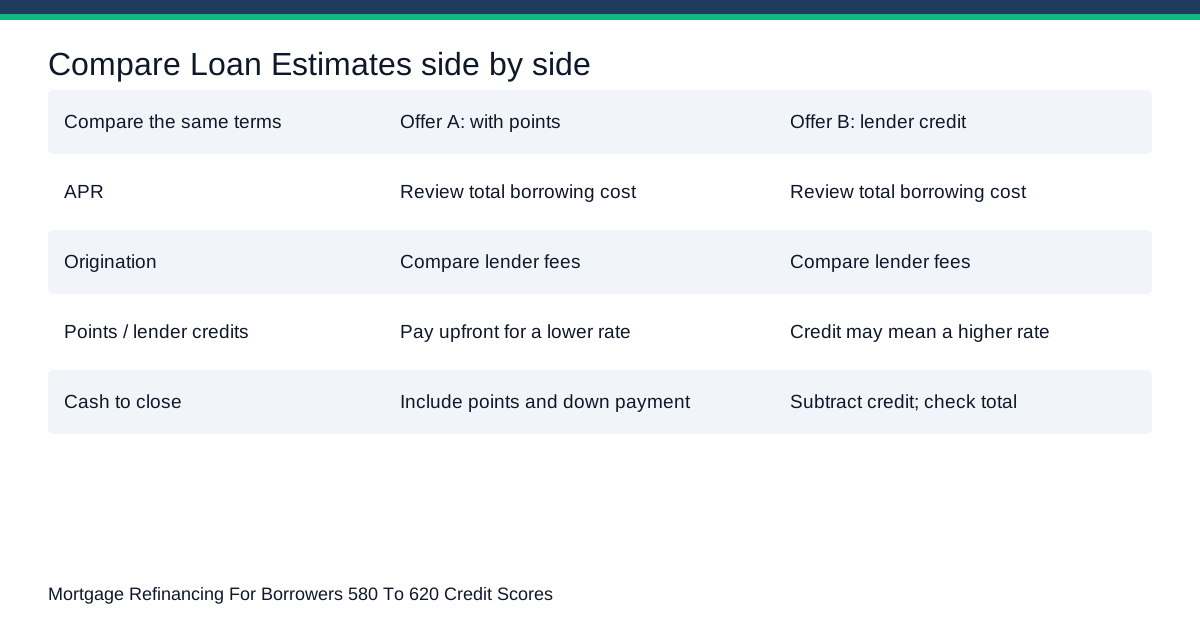
Compare Loan Estimates for the same loan type and term. Include closing costs when calculating whether refinancing saves money.
The structural limitation is non-negotiable: a retail loan officer can only offer what their institution has. If their cheapest FHA product requires 620 FICO and your score is 608, the conversation ends there regardless of how strong the rest of your file is. They cannot shop your file to find a more accommodating lender, and they typically run a hard inquiry before communicating that their guidelines won't accommodate you.
Pros: No intermediary cost layer; familiar institution; potential relationship-based pricing at 610–620 FICO; straightforward process for borrowers with simple profiles.
Cons: Single product menu with no competitive shopping; overlays frequently exceed FHA minimums; loan officer has no incentive to advocate for a file their institution cannot close; may run a hard inquiry before disclosing a likely denial.
Online Lender Platform: Speed With Important Caveats
Major online direct lenders have digitized most of the refinance workflow — income verification, asset checks, automated appraisal waivers in qualifying cases, and e-signature closing. For a borrower at 600–620 with W-2 income and a clean bank statement history, these platforms can compress time to close into the 21–35 day range and offer competitive origination fees relative to retail. Most major online lenders offer FHA refinance products and advertise credit score floors of 580.
The caveat for near-minimum FICO borrowers: automated underwriting engines can be systematically less flexible than a human underwriter reviewing compensating factors. A 585 FICO with strong reserves, a 34% DTI, and 10 years of stable employment may close cleanly through a manually-underwritten broker file but receive an automated denial from an online lender's system. Read the fine print — advertised floors of 580 often reflect the technical minimum, not the realistic approval rate at that score.
Pros: Fastest average close times; often lower origination fees than retail; transparent digital fee disclosure; strong option for FHA streamline-eligible borrowers with clean profiles.
Cons: Less flexible for complex or borderline files; limited human underwriter advocacy at 580–599; single lender without competitive shopping; advertised minimums may not reflect actual approval rates.
True DIY — Independent Rate Shopping: Maximum Control, Maximum Risk
The true DIY path means the borrower independently identifies FHA-approved lenders, submits applications directly, compares standardized Loan Estimates, and navigates the closing process without any professional intermediary. Under the CFPB's Know Before You Owe rules, any lender that receives a complete application must issue a Loan Estimate within three business days — providing a legally standardized disclosure that makes cost comparison genuinely actionable for motivated borrowers.
The FICO protection that makes this viable: credit bureaus and scoring models allow mortgage rate-shopping inquiries to be grouped as a single inquiry if they occur within a defined window. FICO models use a 45-day window; VantageScore uses 14 days. This means submitting five applications in two weeks generates no more score damage than a single application — largely eliminating the "credit-protection" argument for using only one lender. The CFPB's mortgage shopping worksheet formalizes this comparison process.
The genuine risk is file quality. A 580 FICO application is scrutinized closely — every unexplained deposit, employment gap, or open collections account will be flagged in underwriting. Without a broker reviewing the file first, errors reach underwriters at lenders who have no institutional loyalty to making your deal work.
Pros: No broker compensation; full borrower control; Loan Estimate comparison is legally standardized and actionable; FICO score protection through rate-shopping window.
Cons: High time investment in research, applications, and follow-up; no file-preparation advocate; error risk on borderline files can cascade into multiple denials; requires specific knowledge of which lenders honor the 580 FHA floor without overlay.
HUD Counselor + Self-Directed Hybrid: The Underused Third Path
HUD-approved housing counseling agencies provide free or low-cost (typically capped at $50–125 per session for full guidance) pre-refinance counseling from nonprofit counselors who are explicitly prohibited from receiving any compensation from lenders, brokers, or other financial parties. A session typically covers your current loan's terms and servicer obligations, whether refinancing creates a net tangible benefit under FHA's standards, how to read and compare Loan Estimates, and which lenders in your region serve borrowers at your credit tier. Critically, the counselor does not submit your application or shop your rate — you execute the application yourself after the education.
This path delivers the most value for borrowers at 580–600 who have already received unsolicited offers from high-cost lenders. HUD counselors are trained to identify predatory loan structures — excessive prepayment penalties, inflated origination fees, points-heavy pricing that front-loads lender profit — that an inexperienced DIY borrower could easily overlook when comparing rate-only figures.
Pros: Free or very low cost; completely unbiased guidance with no lender compensation conflict; strong protection against predatory offers targeting near-prime borrowers; useful even before choosing a channel.
Cons: Counselor does not execute the refinance; adds meaningful time to the overall process; borrower still bears all execution and documentation risk; counselor's lender knowledge varies by region.
Want professional guidance matched to your score range? Request a free consultation — our team connects 580–620 borrowers with lenders who actually approve near-prime refinances in 2026.
What Matters Beyond the Headline Numbers
The Overlay Problem: Why FHA's Published 580 Floor Is Not the Real Floor
FHA's 580 minimum FICO is one of the most misunderstood facts in near-prime mortgage refinancing. FHA insures the loan against default; it does not originate it. Every FHA loan is underwritten by an FHA-approved lender who sets their own credit minimums above FHA's floor. Research and lender surveys consistently show that a material share of FHA-approved lenders require 600–620 minimum FICO, even for FHA products, because their warehouse lines, investor agreements, or risk models demand it. The practical consequence for a 588 FICO borrower applying through a retail bank or a single online lender: they may receive a denial from an institution that is technically FHA-approved, simply because that institution's overlay exceeds their score. A full-service broker's wholesale network — often spanning 20–50+ lenders — dramatically increases the probability of finding a 580-honoring lender efficiently and without burning multiple hard inquiries across weeks.
The Break-Even Calculation: When Broker Cost Is Justified
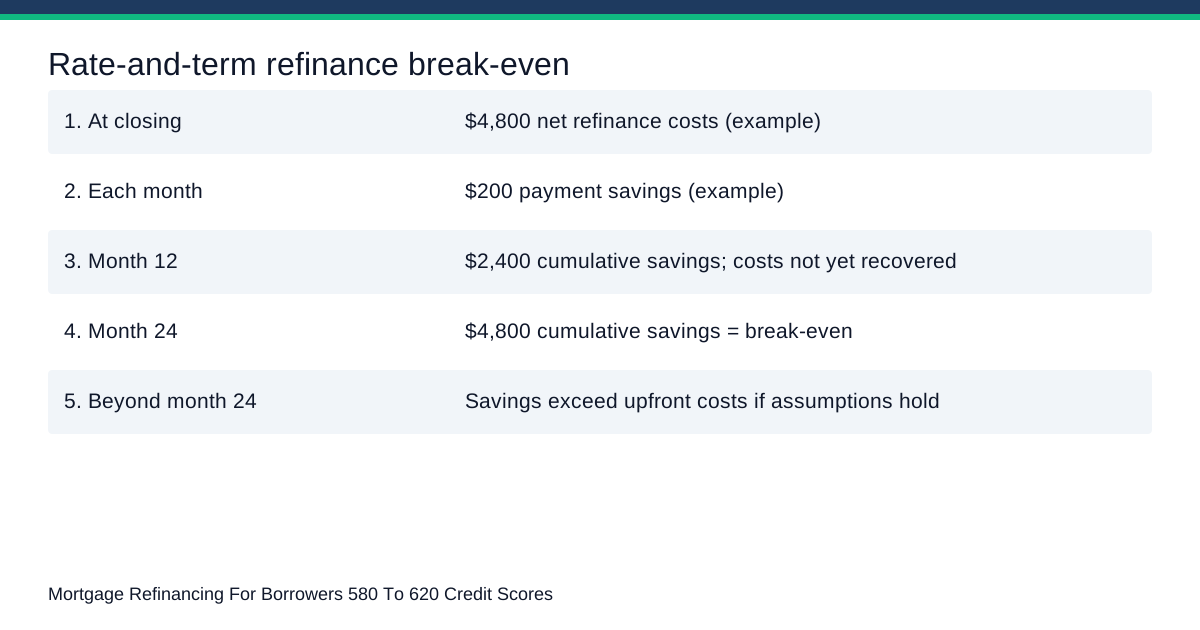
The comparison between a broker path (0.125–0.25% rate premium from embedded compensation) and a direct path (potentially lower rate, higher documentation and timeline risk) should be modeled against break-even time, not evaluated on rate alone. If broker-guided processing saves three months of rejected applications and one relocking event, the eliminated payments and avoided rate-lock costs frequently exceed any rate premium over a five-year hold. The standard break-even formula applies: divide total refinance closing costs by the monthly payment reduction. Compare that horizon to your realistic expected stay in the home. If the broker's higher rate extends break-even by four months but eliminates a 90-day timeline loss, the net math often favors the broker path at 580–610 FICO.
DTI Matters as Much as FICO in Near-Prime Underwriting
Credit score drives lender access; debt-to-income ratio drives actual underwriting approval. FHA guidelines permit back-end DTIs up to 57% with an automated underwriting system approval, but lender overlays on borrowers below 620 frequently cap at 43–50% DTI. A borrower at 595 FICO with a 36% DTI has meaningfully stronger cross-channel approval odds than a 614 FICO borrower carrying 54% DTI — regardless of which refinancing path they choose. Paying down revolving balances before application (which simultaneously improves both FICO and DTI) is often more impactful than channel selection alone. This is the type of optimization a free HUD counseling session or a pre-application consultation is well-positioned to surface before any hard inquiry is run.
Rate-Lock Timing Exposure in the DIY Path
In a volatile rate environment, the additional 10–20 days that application errors, documentation requests, or resubmissions add to a DIY timeline translates directly into rate-lock exposure. A standard 30- or 45-day lock that expires while a corrected application is in process forces a relocking at current market rates — potentially on worse terms than the original lock. When rates move 0.25% between lock and relock, the entire NPV of the refinance can be eliminated on a $300,000 loan. Professional brokers manage lock timing as a core service function; DIY borrowers must actively track expiration dates and proactively request extensions or relocks at their own cost.
Authoritative Guidance & Official Standards
The following government and regulatory resources establish the standards underpinning this comparison. Their guidance informs the decision context but does not constitute endorsement of any lender, broker, or platform.
- CFPB — Know Before You Owe: Mortgage Closing: Explains the mandatory three-business-day Loan Estimate and Closing Disclosure requirements, supporting both DIY rate-shopping and borrower verification of broker-submitted terms.
- CFPB — Mortgage Shopping Worksheet: A standardized comparison tool for evaluating multiple Loan Estimates across interest rate, APR, monthly payment, and closing cost components — the foundational document for any DIY or hybrid borrower comparing offers.
- HUD — Housing Counseling Agency Locator: The official searchable directory of HUD-approved housing counseling agencies, providing free or low-cost pre-refinance counseling by state. HUD counselors are prohibited from receiving compensation from lenders.
- HUD — FHA Single Family Loan Programs: Published FHA underwriting requirements including the 580 minimum FICO threshold for 3.5% equity refinancing — the baseline that individual lender overlays modify upward.
- FTC — Mortgage Discrimination: Explains Fair Housing Act and Equal Credit Opportunity Act protections for borrowers who believe a denial may be inconsistent with the lender's published credit requirements — relevant context for near-prime borrowers navigating overlay denials.
Questions to Answer Before Deciding (FAQ)
What credit score do I actually need to refinance a mortgage in 2026?
The technical FHA minimum for a rate-and-term or FHA-to-FHA streamline refinance is 580 FICO. Conventional refinances backed by Fannie Mae or Freddie Mac require a minimum 620 FICO. Because most retail lenders apply overlays above these floors, the practical approval threshold at many institutions is 600–620 even for FHA products. This means borrowers at 580–599 are almost exclusively limited to the FHA path, and locating a lender who accepts that score without overlay — something a full-service broker does systematically — is the critical first obstacle. At 600–620, both FHA and limited conventional options may open depending on LTV and DTI.
Does shopping multiple lenders hurt my credit score?
Not meaningfully, provided you shop within the rate-shopping window. FICO's published scoring methodology treats multiple mortgage inquiries within a 45-day window as a single inquiry for scoring purposes. VantageScore applies a 14-day window. Submitting five applications in two weeks generates the same score impact as one application. This largely eliminates the "credit protection" rationale for limiting yourself to a single lender — the broker path's advantage lies in file preparation and lender selection, not in inquiry consolidation. The CFPB explicitly encourages rate shopping and provides a standardized worksheet for comparing Loan Estimates.
How much does a mortgage broker actually add to my refinance cost?
Broker compensation is disclosed on the Loan Estimate under "Origination Charges." Under lender-paid compensation — the most common model — the fee is embedded in your interest rate rather than appearing as a cash charge. The rate premium typically ranges from 0.125% to 0.25% above the wholesale rate, depending on the broker's compensation agreement. Under borrower-paid compensation, it appears as an explicit origination fee (typically 1–2% of the loan amount) with a correspondingly lower interest rate offered. Neither model is inherently more expensive — the right comparison is total cost over your expected holding period. For a 580 FICO borrower, the broker's access to wholesale lenders who honor the floor without overlay often more than offsets the compensation premium versus a retail denial-and-reapplication scenario.
Is FHA Streamline Refinance a good DIY candidate for 580–620 borrowers?
FHA Streamline is the most DIY-accessible refinance product for existing FHA loan holders in this credit range. Because it waives the new appraisal requirement in many cases and applies a simplified documentation standard — the primary requirement is demonstrating a "net tangible benefit," typically a 0.5% reduction in the combined interest and mortgage insurance premium rate — the documentation complexity is materially lower than a standard rate-and-term refinance. You must already hold an FHA-insured loan, be current on payments with no 30-day late payment in the past 12 months, and apply through an FHA-approved lender. Even on a streamline, a broker specializing in near-prime FHA files can often identify lenders with lower lender fees and faster timelines than a borrower comparing options independently.
What happens to my application if I get denied — does it make the next lender more likely to say no?
A denial does not appear on your credit report and does not lower your FICO score on its own. The associated hard inquiry — which does appear — typically causes a decrease of five points or fewer, according to FICO's published guidance, and the impact diminishes within 12 months. The more consequential risk of a denial is what it reveals about an unresolved file issue: an open collections account, a DTI that exceeds the lender's overlay, or income documentation gaps that will recur with every subsequent application until addressed. A pre-application review by a broker or HUD counselor can surface these issues before any inquiry is run, which is a stronger use of that pre-application time than focusing on which channel to apply through.
Can I negotiate closing costs regardless of which path I choose?
Yes, and the CFPB's Know Before You Owe framework makes this explicit. The Loan Estimate identifies which third-party service fees — title, settlement, pest inspection — you are permitted to shop independently even after selecting a lender or broker. Lender origination fees are also negotiable, particularly when you present a competing Loan Estimate from another lender. Both DIY and broker-path borrowers should treat the first Loan Estimate as a starting offer, not a fixed price. Closing costs on a refinance are among the most negotiable expenses in a consumer financial transaction, and the standardized Loan Estimate format exists specifically to facilitate that comparison.
Related Guides
- Mortgage Refinancing Cost & Pricing Guide 2026: What 580–620 Credit Score Borrowers Actually Pay — detailed breakdown of closing costs, origination fees, broker compensation structures, and how to calculate your break-even horizon before committing to a path.
- What Is a Good Credit Score for Refinancing a Mortgage? (2026 Guide) — how FICO tiers map to FHA and conventional lender requirements, which compensating factors move the needle at 580–620, and what a realistic 60-day score improvement looks like.
- How to Choose the Right Mortgage Refinancing Provider (2026 Guide for 580–620 Credit Scores) — vetting criteria for brokers, retail loan officers, and online platforms when your credit score limits your options and due diligence matters most.
The Bottom Line
For the majority of borrowers in the 580–620 FICO range, a full-service mortgage broker with a verified wholesale lender panel offers the best combination of approval probability, rate competition, and file-preparation support. The cost — lender-paid compensation typically embedded as a 0.125–0.25% rate premium — is justified for most borrowers below 605 FICO by the access it buys to lenders who honor the FHA floor without overlay and by the reduction in documentation error risk on a file with no margin for mistakes.
The broker advantage narrows substantially as FICO approaches 620 and the borrower's income documentation is straightforward. A 618 FICO borrower with W-2 income, a 38% DTI, and an existing FHA loan may execute a streamline refinance through an online lender platform faster and at lower total cost than the broker route. A 584 FICO borrower with 1099 income and an unresolved medical collection should not attempt to navigate wholesale underwriting without professional representation.
The HUD counselor hybrid is the most underused option: it is free, completely unbiased, and specifically protective against the high-cost predatory offers that disproportionately target near-prime borrowers. Consider a HUD counseling session before committing to any path — it costs nothing and can prevent an expensive mistake.
Your next step: Know your current FICO score, your loan's outstanding balance and existing rate, and your estimated home value before any application generates a hard inquiry. If you are at 580–604 or uncertain about your documentation package, start with a pre-application consultation before selecting a channel.
Ready to see which lenders will actually approve your score? See if you qualify in 60 seconds — we connect 580–620 borrowers with the lenders who close near-prime refinances in 2026.
Key Takeaways
- Understanding your options for professional vs diy mortgage refinancing comparison is the first step
- Getting pre-qualified helps you understand your real options