Compare Live Mortgage & Home Equity Rates
Compare current APRs, points, fees, and estimated monthly payments from participating lenders below.
Mortgage rates
No Closing Cost Refinance Options for Poor Credit Borrowers: Your Complete 2026 Guide
Quick Answer: Yes, no closing cost refinance options exist for borrowers with credit scores between 580 and 620. These programs allow you to refinance without paying upfront fees by either rolling costs into the loan balance or accepting a slightly higher interest rate. Government-backed loans like FHA Streamline and VA IRRRL are particularly accessible for this credit range.
If you have a credit score between 580 and 620 and are struggling with high mortgage payments, No Closing Cost Refinance Options for Poor Credit Borrowers do exist and could help you lower your monthly expenses without paying thousands upfront. These specialized refinancing programs allow homeowners with challenged credit to restructure their mortgages by rolling closing costs into the loan balance or having the lender cover fees in exchange for a slightly higher interest rate. While your credit score limits some options, government-backed programs like FHA Streamline Refinance and VA IRRRL, along with select conventional no-closing-cost products, remain accessible and can provide genuine financial relief even when your credit history isn't perfect.
Understanding No Closing Cost Refinancing with Poor Credit
Traditional mortgage refinancing typically requires borrowers to pay between $3,500 and $6,800 in closing costs, including appraisal fees, title insurance, origination charges, and various administrative expenses. For borrowers with credit scores in the 580-620 range, these upfront costs create a significant barrier to accessing better loan terms.
No closing cost refinancing eliminates this obstacle through two primary structures. The first approach involves the lender covering your closing costs in exchange for a higher interest rate—typically 0.25% to 0.50% above the standard rate for your credit profile. The second method rolls all closing costs into your new loan balance, increasing the total amount you owe but preserving your cash reserves.
For poor credit borrowers, these options prove particularly valuable because building substantial savings while managing credit challenges often creates a catch-22 situation. You need to refinance to reduce payments, but can't afford the closing costs without the payment reduction. No closing cost programs break this cycle.
The trade-off requires careful consideration. While you preserve cash today, you'll pay more over the loan's lifetime through either higher interest charges or a larger principal balance. However, if refinancing reduces your monthly payment by $150-$400, the immediate budget relief often justifies the long-term cost increase, especially if you plan to sell or refinance again within 5-7 years.
Government-Backed Refinance Programs for 580-620 Credit Scores
FHA Streamline Refinance
The FHA Streamline Refinance program stands as one of the most accessible No Closing Cost Refinance Options for Poor Credit Borrowers. If you currently have an FHA-insured mortgage, this program allows refinancing with minimal credit verification and no appraisal requirement in most cases.
Credit requirements remain flexible—many lenders accept scores as low as 580, with some considering borrowers at 540 if compensating factors exist. The program requires that you've made your last six mortgage payments on time and haven't had more than one 30-day late payment in the past twelve months.
The streamlined process significantly reduces paperwork and processing time. No income verification or employment documentation is required, making this ideal for self-employed borrowers or those with irregular income. Closing costs typically range from $2,800 to $5,200, which can be rolled into your new loan balance or covered by accepting a higher interest rate.
Expert Tip
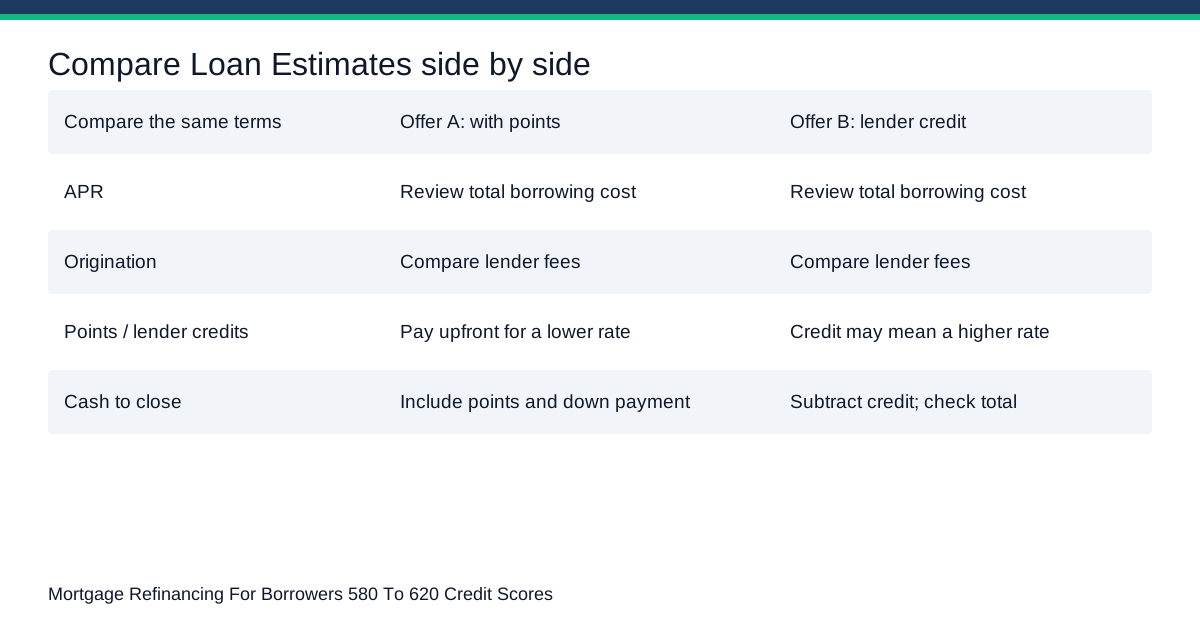
Compare Loan Estimates for the same loan type and term. Include closing costs when calculating whether refinancing saves money.
VA Interest Rate Reduction Refinance Loan (IRRRL)
Military service members, veterans, and eligible surviving spouses can access the VA IRRRL program regardless of credit score challenges. This program doesn't establish a minimum credit score requirement, though individual lenders may impose overlays typically between 580-600.
The VA IRRRL focuses exclusively on reducing your interest rate and requires no appraisal, no income verification, and minimal documentation. The VA funding fee of 0.5% of the loan amount can be financed into the loan, and all other closing costs—ranging from $2,400 to $4,800—can similarly be rolled into the new mortgage or covered through lender credits.
This program requires only that you're current on your existing VA loan and can demonstrate that refinancing provides a clear financial benefit through reduced payments or conversion from an adjustable-rate to fixed-rate mortgage.
USDA Streamlined Assist Refinance
Homeowners in eligible rural and suburban areas with existing USDA loans can utilize the Streamlined Assist Refinance program. Credit score requirements start at 580 for most lenders, and the program mandates no appraisal, reduced documentation, and faster processing.
Closing costs between $2,600 and $4,900 can be incorporated into the new loan amount. The program requires that you're current on your mortgage with no late payments in the past 180 days and that refinancing reduces your interest rate by at least one percentage point.
Conventional No Closing Cost Refinance Pathways
While government-backed programs offer the most accessible routes for poor credit borrowers, certain conventional refinancing options remain available for credit scores in the 600-620 range.
Lender-Paid Closing Costs
Many mortgage lenders offer programs where they cover your closing costs in exchange for a permanently higher interest rate. For borrowers with 600-620 credit scores, this typically means accepting rates 0.375% to 0.625% above the standard rate for your credit tier.
Rate Trade-off Example:
- Standard rate for 610 credit score: 7.25%
- Lender-paid closing cost rate: 7.625% to 7.875%
- Closing costs covered: $4,200-$6,400
- Monthly payment increase: $85-$180 on a $250,000 loan
Portfolio Lenders and Credit Unions
Portfolio lenders—financial institutions that keep loans on their own books rather than selling them—sometimes offer flexible refinancing programs with negotiable closing cost structures. Credit unions, particularly those serving specific employment sectors or communities, may provide member-focused refinancing with reduced or rolled-in closing costs.
These institutions evaluate borrowers more holistically, considering factors beyond credit scores such as employment stability, deposit relationships, and debt-to-income ratios. Borrowers in the 580-620 range with strong compensating factors (significant equity, stable employment history, improved payment patterns) may access favorable terms.
Step-by-Step Process for Securing No Closing Cost Refinancing
1. Review Your Current Mortgage Details Gather your existing loan documents to identify your current interest rate, remaining balance, monthly payment, and loan type. Determine whether you have an FHA, VA, USDA, or conventional mortgage, as this shapes your refinancing pathway.
2. Obtain Your Credit Reports and Scores Pull reports from all three bureaus (Experian, Equifax, TransUnion) to verify your scores and identify any errors. Dispute inaccuracies immediately, as even small score improvements expand your options. Most lenders use your middle score when evaluating applications.
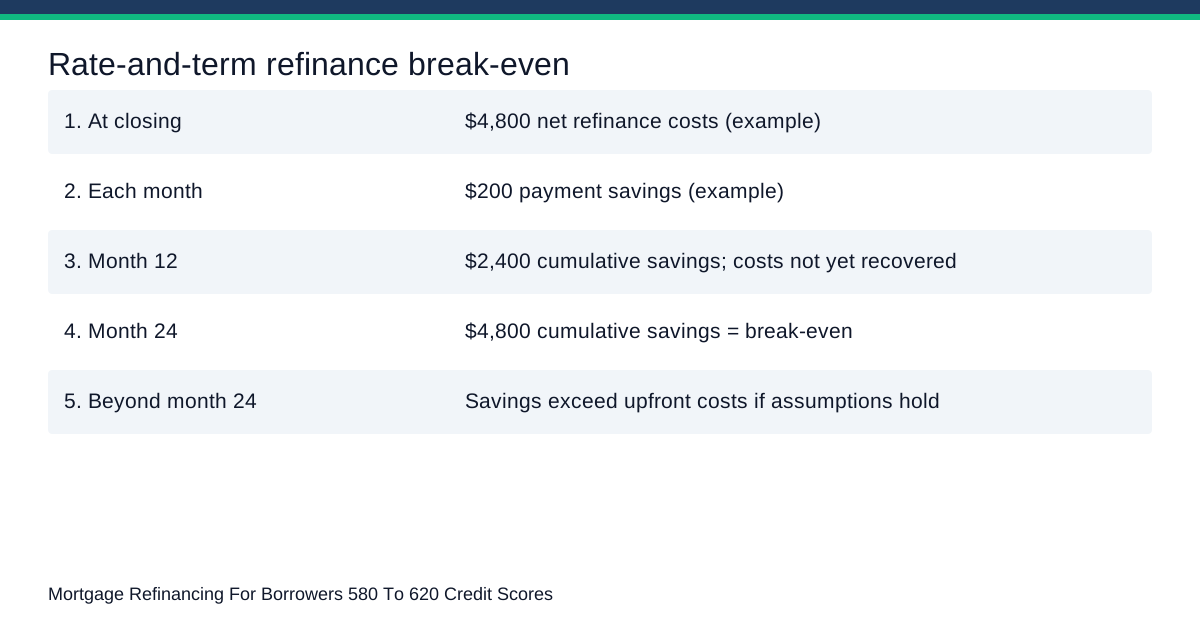
3. Calculate Your Break-Even Point Determine how long you plan to keep your home and calculate whether accepting a higher interest rate or larger loan balance justifies avoiding upfront costs. If you're rolling $5,000 in closing costs into your loan and reducing your payment by $200 monthly, your break-even point is 25 months.
4. Compare Multiple Lender Offers Contact at least 3-5 lenders specializing in poor credit refinancing. Request detailed Loan Estimates showing exactly how closing costs would be handled—through higher rates, rolled into the balance, or a combination. Compare the annual percentage rate (APR), which reflects the true cost including all fees.
5. Gather Required Documentation Even for streamlined programs, prepare basic documentation: two years of tax returns, recent pay stubs, bank statements showing two months of reserves, and homeowners insurance information. Having documents ready accelerates processing.
6. Submit Your Application Complete applications with your top 2-3 lender choices within a 14-day window to minimize credit score impact (multiple mortgage inquiries within this timeframe count as a single inquiry). Lock your interest rate when offered if it meets your goals.
7. Navigate Underwriting and Closing Respond promptly to underwriter requests for additional documentation. Review your Closing Disclosure three days before closing to verify that terms match your Loan Estimate. Confirm that no unexpected fees have appeared and that the closing cost structure remains as agreed.
Realistic Cost Expectations and Payment Scenarios
Understanding the financial implications of No Closing Cost Refinance Options for Poor Credit Borrowers requires examining concrete scenarios based on 2026 market conditions.
| Original Loan Details | Refinance Option A: Rolled Costs | Refinance Option B: Higher Rate | Refinance Option C: Standard |
|---|---|---|---|
| Balance: $200,000 | New Balance: $204,800 | New Balance: $200,000 | Balance: $200,000 |
| Rate: 7.75% | Rate: 6.875% | Rate: 7.25% | Rate: 6.875% |
| Payment: $1,436 | Payment: $1,348 | Payment: $1,361 | Payment: $1,316 + $4,800 upfront |
| Monthly Savings | $88 | $75 | $120 |
| Break-Even Point | N/A (no upfront cost) | N/A (no upfront cost) | 40 months |
| 5-Year Total Cost | $80,880 | $81,660 | $79,760 |
This comparison illustrates critical decision points. Option C provides the lowest long-term cost but requires $4,800 upfront—money that borrowers with challenged credit often don't have available. Option A offers moderate savings with no upfront costs but increases your principal balance. Option B provides immediate monthly relief while keeping your balance unchanged but costs more over time due to the higher rate.
For poor credit borrowers, Options A and B typically provide the most practical pathways despite their higher long-term costs, as they eliminate the immediate cash requirement barrier.
Improving Your Approval Odds Despite Credit Challenges
Build a Compensating Factors Portfolio
Lenders evaluating borderline credit applications look for compensating factors that mitigate risk. Strong compensating factors for 580-620 credit borrowers include:
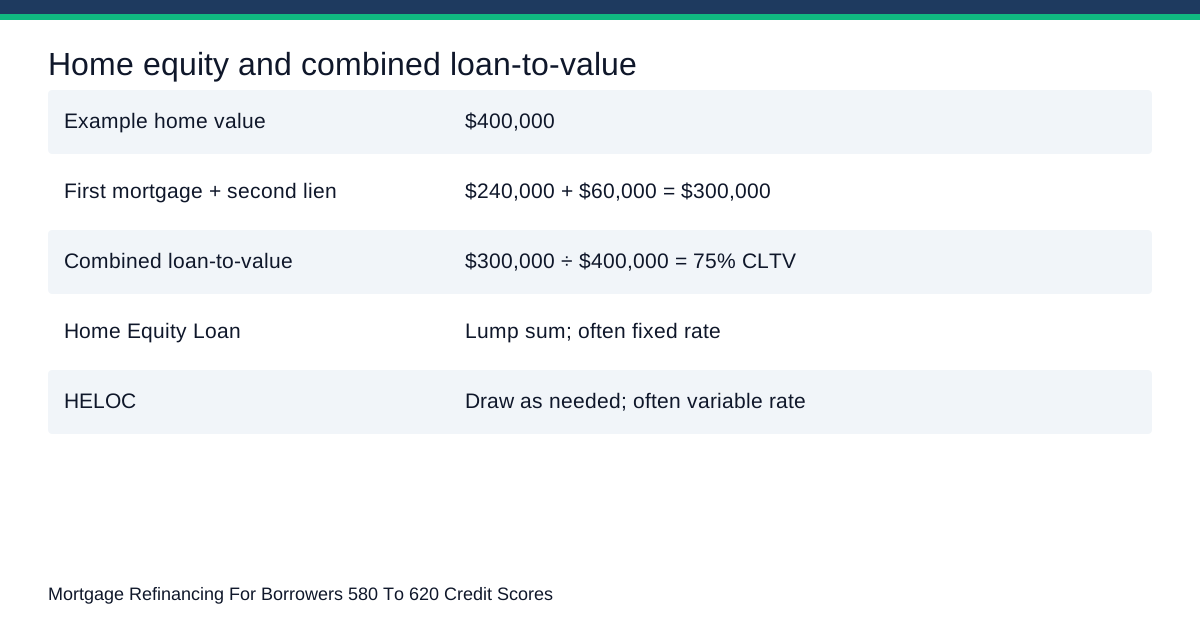
- Significant home equity: Loan-to-value ratios below 75% substantially improve approval odds
- Cash reserves: Bank accounts showing 6-12 months of mortgage payments demonstrate financial stability
- Low debt-to-income ratio: Keeping total monthly debt payments below 36% of gross income strengthens applications
- Payment history improvement: Demonstrating 12+ months of on-time mortgage payments shows positive trajectory
- Stable employment: Three or more years with the same employer or in the same field reduces perceived risk
Strategic Timing Considerations
Timing your refinance application strategically can improve outcomes:
- Wait at least 6-12 months after any major credit event (bankruptcy discharge, foreclosure, short sale)
- Apply after establishing at least six consecutive on-time mortgage payments
- Avoid refinancing within 90 days of opening new credit accounts or making large purchases
- Consider waiting if you're within 30-60 points of the next credit tier (620 opens significantly more options)
Working with Specialized Brokers
Mortgage brokers specializing in challenged credit scenarios maintain relationships with lenders offering poor credit programs that don't appear on mainstream comparison sites. These brokers understand which lenders accept 580-score applicants, which waive specific requirements, and how to structure applications to maximize approval probability.
Broker fees typically range from $1,500 to $3,500 but can be incorporated into no closing cost structures. The specialized expertise often justifies the cost by accessing programs you couldn't find independently.
Common Mistakes to Avoid
Focusing Exclusively on Interest Rates: Borrowers with poor credit sometimes accept predatory terms by fixating only on rate reductions. Always evaluate the complete package—fees, terms, and total cost over your expected holding period.
Ignoring Cash-Out Limits: Some no closing cost programs prohibit cash-out refinancing or limit the maximum loan-to-value ratio. If you need cash for debt consolidation or home improvements, verify that your chosen program allows this.
Overlooking Prepayment Penalties: Some poor credit refinance products include prepayment penalties that charge fees if you pay off or refinance the loan within 2-5 years. Read all disclosures carefully before committing.
Underestimating the Value of Rate Shopping: Interest rate differences of just 0.25% translate to thousands in long-term costs. Borrowers with challenged credit sometimes accept the first approval, but comparing multiple offers typically yields savings of $30-$150 monthly.
Refinancing Too Frequently: While refinancing can provide relief, doing so repeatedly every 1-2 years creates a pattern of extending your loan term and perpetually restarting the amortization schedule, costing substantial equity over time.
Frequently Asked Questions
A: Yes, but timing matters significantly. FHA Streamline and VA IRRRL programs may allow refinancing as soon as 12 months after bankruptcy discharge if you've maintained perfect payment history on your current mortgage. Conventional programs typically require 2-4 years of waiting period after bankruptcy and 3-7 years after foreclosure. Some portfolio lenders offer more flexibility, potentially refinancing within 6-12 months of bankruptcy discharge if substantial compensating factors exist.
Q: How much can I save monthly with poor credit refinancing if my current rate is 8.5%?
A: Monthly savings depend on your loan balance and the new rate you qualify for. On a $200,000 mortgage at 8.5%, your principal and interest payment is approximately $1,538. Refinancing to 7.25% (realistic for 600-620 scores in 2026) reduces this to $1,361—a savings of $177 monthly or $2,124 annually. At 580-590 credit scores, rates of 7.5-7.75% are more typical, yielding savings of $120-$150 monthly on the same balance.
Q: Do no closing cost refinance options require home appraisals for poor credit borrowers?
A: Most government streamline programs (FHA Streamline, VA IRRRL, USDA Streamlined Assist) specifically waive appraisal requirements, making them ideal for poor credit borrowers who may have limited equity. Conventional no closing cost refinances typically do require appraisals unless you qualify for an appraisal waiver through automated systems, which is less common with credit scores below 620. Appraisal costs ($450-$750) can be rolled into the loan balance or covered through lender credits in no closing cost structures.
Q: Will refinancing with poor credit hurt my credit score further?
A: The initial credit inquiry for refinancing typically reduces your score by 3-7 points temporarily. However, if refinancing reduces your debt-to-income ratio or helps you avoid late payments by lowering monthly costs, the long-term credit impact is positive. Multiple refinance inquiries within a 14-day period count as a single inquiry, so shopping rates doesn't multiply the impact. Most borrowers see their scores return to pre-application levels within 3-6 months.
Q: What's the minimum loan amount for no closing cost refinancing with a 580-620 credit score?
A: Most lenders set minimum refinance amounts between $75,000 and $100,000. Loans below these thresholds often don't generate sufficient lender revenue to justify covering closing costs. Some credit unions and portfolio lenders offer programs for balances as low as $50,000, but options narrow significantly. If your loan balance is below $75,000, expect limited choices and potentially less favorable terms, though FHA Streamline and VA IRRRL programs may still accommodate smaller balances.
Take the Next Step Toward Lower Mortgage Payments
No Closing Cost Refinance Options for Poor Credit Borrowers provide genuine opportunities to reduce monthly expenses, stabilize your budget, and work toward long-term financial recovery—even when your credit score falls short of traditional lending standards. The programs outlined in this guide have helped thousands of homeowners in your situation access better mortgage terms without the barrier of thousands in upfront costs.
Your credit challenges don't define your financial future. The right refinancing strategy can provide immediate monthly relief while you continue improving your credit profile for even better opportunities ahead.
Ready to explore your refinancing options? Our network of specialized lenders works exclusively with borrowers in the 580-620 credit range and can provide personalized quotes for no closing cost refinance programs within 24 hours. Request your free, no-obligation consultation today to discover exactly how much you could save monthly without paying any money upfront. Complete the simple form or call our credit-challenged borrower specialists to take the first step toward more affordable homeownership.
Frequently Asked Questions
How does no closing cost refinancing work for borrowers with poor credit?
No closing cost refinancing works by either having the lender cover your closing costs in exchange for a higher interest rate, or by adding the closing costs to your loan balance. This eliminates the need for upfront cash, making refinancing more accessible for borrowers with credit scores between 580 and 620 who may not have significant savings.
What are the eligibility requirements for FHA Streamline Refinance with a 580 credit score?
For FHA Streamline Refinance, you must currently have an FHA-insured mortgage, have made your last six payments on time, and have no more than one 30-day late payment in the past twelve months. Credit scores as low as 580 are typically accepted, and no appraisal or income verification is usually required.
Can I refinance with a 580 credit score without paying closing costs?
Yes, you can refinance with a 580 credit score without paying closing costs upfront. Options include rolling closing costs into the loan balance or accepting a lender credit in exchange for a higher interest rate. Government programs like FHA Streamline and VA IRRRL often allow this structure for qualified borrowers.
What are the trade-offs of no closing cost refinancing for poor credit borrowers?
The main trade-off is that you'll pay more over the life of the loan, either through a higher interest rate or a larger principal balance. However, if refinancing reduces your monthly payment, the immediate budget relief can outweigh the long-term cost, especially if you plan to sell or refinance again within a few years.
Key Takeaways
- Understanding your options for no closing cost refinance options for poor credit borrowers is the first step
- Getting pre-qualified helps you understand your real options