Compare Live Mortgage & Home Equity Rates
Compare current APRs, points, fees, and estimated monthly payments from participating lenders below.
Mortgage rates
How to Qualify for Refinance With 590 Credit and High Income
Quick Answer: To qualify for a refinance with a 590 credit score and high income, focus on government-backed programs like FHA or VA loans, which accept lower credit scores. Your high income can offset credit risk by improving your debt-to-income ratio and demonstrating payment ability. Lenders may also consider portfolio loans that evaluate your overall financial profile.
If you're wondering how to qualify for refinance with 590 credit and high income, the good news is that your strong earnings can help offset credit challenges when seeking mortgage refinancing. Lenders increasingly recognize that credit scores don't tell the complete financial story, and borrowers with credit scores in the 580-620 range who demonstrate substantial, stable income can still access refinancing options. While traditional conventional refinancing typically requires credit scores of 620 or higher, government-backed programs like FHA and VA loans offer pathways for borrowers with 590 credit scores, and portfolio lenders may approve refinances based on comprehensive financial profiles that emphasize income stability, debt-to-income ratios, and compensating factors rather than credit scores alone.
The key to successfully refinancing with a 590 credit score lies in understanding which loan programs accept lower credit thresholds, how to leverage your high income as a compensating factor, and what documentation lenders need to approve your application. This guide walks you through every step of the qualification process.
When considering how to qualify for refinance with 590 credit and high income, you should understand all available options.
Understanding Refinance Options for 580-620 Credit Scores
Borrowers with credit scores between 580 and 620 have several refinancing pathways available, though conventional loans generally remain out of reach until you cross the 620 threshold.
FHA Streamline Refinance
The FHA Streamline Refinance program allows current FHA loan holders with 580-620 credit scores to refinance with minimal documentation. This program doesn't require a new appraisal in most cases and focuses primarily on demonstrating that refinancing will reduce your monthly payment. Credit score requirements are flexible, with most lenders accepting scores as low as 580, and some even going to 500 with additional compensating factors.
For 2026, FHA loans require an upfront mortgage insurance premium of 1.75% of the loan amount, plus annual mortgage insurance premiums ranging from 0.55% to 0.85% depending on your loan-to-value ratio and term length.
FHA Cash-Out Refinance
If you need to access your home's equity while refinancing, FHA cash-out refinancing accepts borrowers with 580+ credit scores. These loans require a full appraisal and more extensive documentation than streamline refinances, but your high income becomes a significant advantage during underwriting.
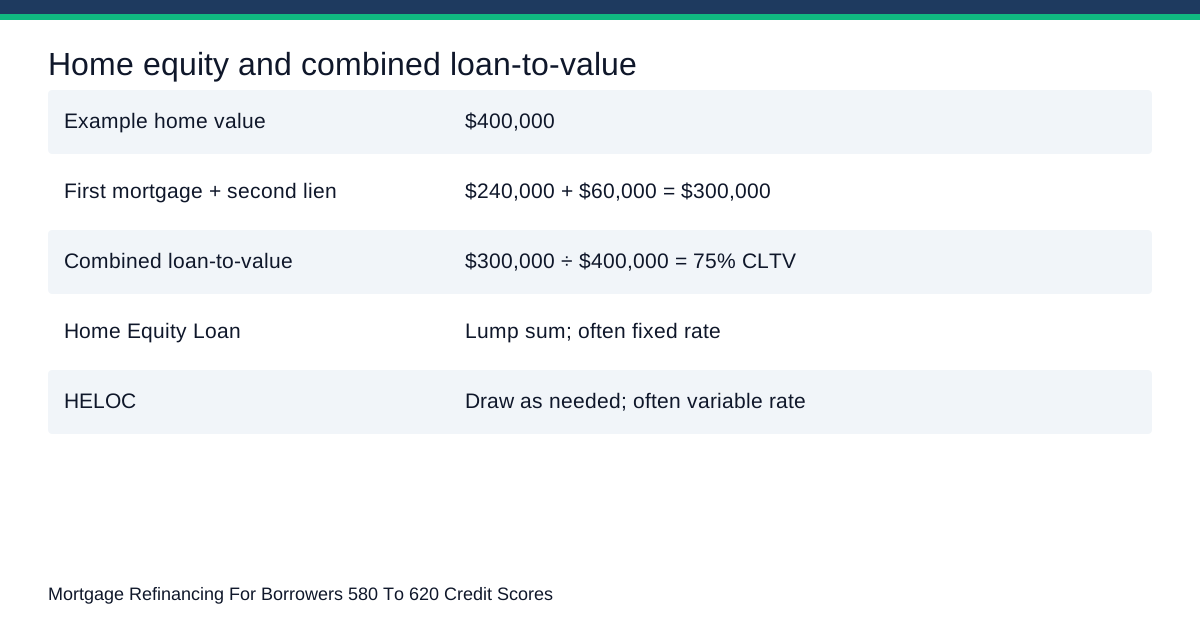
Maximum loan-to-value ratios for FHA cash-out refinances typically cap at 80%, meaning you'll need at least 20% equity in your property.
VA Interest Rate Reduction Refinance Loan (IRRRL)
Military service members, veterans, and eligible spouses with existing VA loans can access the VA IRRRL program with no minimum credit score requirement from the VA itself, though individual lenders typically impose overlays requiring scores of 580-620. Your high income helps demonstrate payment stability and reduces lender risk.
Expert Tip
Compare Loan Estimates for the same loan type and term. Include closing costs when calculating whether refinancing saves money.
Portfolio Lenders and Credit Unions
Portfolio lenders who hold loans on their own books rather than selling them on the secondary market often evaluate applications more holistically. These lenders may approve refinances for borrowers with 590 credit scores when strong income, significant assets, or substantial equity demonstrate creditworthiness beyond the score itself.
How High Income Compensates for Lower Credit Scores
Your income level directly impacts your debt-to-income ratio (DTI), which measures monthly debt obligations against gross monthly income. Lenders view DTI as one of the most reliable predictors of loan performance.
Debt-to-Income Ratio Thresholds
Most refinance programs require DTI ratios below specific thresholds:
- FHA loans: Maximum 43% DTI (some lenders allow up to 50% with strong compensating factors)
- VA loans: Generally 41% DTI, though flexibility exists for higher incomes
- Portfolio lenders: Vary widely, from 43% to 55% depending on other factors
Documenting Income Stability
Lenders scrutinize income stability for borrowers with lower credit scores. Prepare to document:
- Two years of W-2 forms for employed borrowers
- Two years of tax returns for self-employed applicants
- Recent pay stubs covering the most recent 30 days
- Verification of employment directly from your employer
- Documentation of additional income from bonuses, commissions, rental properties, investments, or other sources
Reserve Requirements
Many lenders require borrowers with 580-620 credit scores to maintain cash reserves after closing—typically 2-6 months of mortgage payments in liquid assets. High-income earners often meet these requirements more easily, presenting another compensating factor during underwriting.
Step-by-Step Refinancing Process for 590 Credit Borrowers
Successfully navigating refinancing with a 590 credit score requires strategic preparation and understanding of lender expectations.
Step 1: Review Your Credit Reports
Before applying, obtain free credit reports from all three bureaus (Equifax, Experian, TransUnion) and carefully review them for:
- Errors or inaccuracies that could be disputed
- Outstanding collections that might be settled
- Recent negative marks that explain your current score
- Credit utilization ratios above 30%
Step 2: Calculate Your Debt-to-Income Ratio
Add all monthly debt obligations (mortgage, car loans, student loans, credit cards, personal loans) and divide by your gross monthly income. If your DTI exceeds 43%, consider paying down high-interest debts before applying to improve this ratio.
Step 3: Gather Financial Documentation
Compile the comprehensive documentation package lenders require:
- Most recent two years of tax returns with all schedules
- W-2 forms for the same period
- Pay stubs from the last 30-60 days
- Bank statements from the last 60 days for all accounts
- Documentation of additional income sources
- Current mortgage statement
- Homeowner's insurance policy information
- Recent property tax bill
Step 4: Research Specialized Lenders
Not all lenders work with 580-620 credit score borrowers. Focus your search on:
- FHA-approved lenders with flexible underwriting
- Credit unions where you have existing relationships
- Portfolio lenders and community banks
- Online lenders specializing in non-prime borrowers
- Mortgage brokers with access to multiple lender networks
Step 5: Submit Applications to Multiple Lenders
Apply with 3-5 lenders within a 14-45 day window. Credit scoring models treat multiple mortgage inquiries within this timeframe as a single inquiry, minimizing score impact while allowing you to compare offers.
Step 6: Prepare for Manual Underwriting
Applications with 590 credit scores often require manual underwriting rather than automated approval. Underwriters will request detailed explanations for:
- Recent late payments or derogatory marks
- Credit score decreases
- Income fluctuations
- Employment changes
- Large deposits in bank accounts
Step 7: Lock Your Rate and Proceed to Closing
Once approved, you'll receive a Loan Estimate detailing all costs. Review it carefully, lock your interest rate, and prepare for closing within 30-45 days.
Cost Analysis: Refinancing With 590 Credit Score vs. Higher Credit Tiers
Understanding cost differences helps you make informed decisions about timing your refinance.
| Credit Score Range | Interest Rate Premium | APR on $300,000 Loan | Monthly Payment | Total Interest (30 Years) | Upfront Costs Range |
|---|---|---|---|---|---|
| 580-619 | +1.25% to +2.00% | 7.75% - 8.50% | $2,150 - $2,307 | $474,000 - $530,520 | $8,500 - $15,000 |
| 620-639 | +0.75% to +1.25% | 7.25% - 7.75% | $2,047 - $2,150 | $437,000 - $474,000 | $7,000 - $12,000 |
| 640-679 | +0.375% to +0.75% | 6.875% - 7.25% | $1,974 - $2,047 | $410,640 - $437,000 | $6,000 - $10,000 |
| 680-739 | +0.125% to +0.375% | 6.625% - 6.875% | $1,917 - $1,974 | $390,120 - $410,640 | $5,500 - $9,000 |
| 740+ | Baseline | 6.50% - 6.625% | $1,896 - $1,917 | $382,560 - $390,120 | $5,000 - $8,500 |
Rates current as of early 2026 market conditions; actual rates vary by lender and individual circumstances.
The rate premium for 590 credit scores adds approximately $200-400 monthly compared to prime borrowers, translating to $72,000-$144,000 in additional interest over a 30-year term. However, refinancing may still make financial sense if you're:
- Reducing your current interest rate by 0.75% or more
- Accessing equity for high-interest debt consolidation
- Converting from an adjustable-rate to fixed-rate mortgage
- Removing mortgage insurance on a conventional loan by refinancing to FHA or VA
Strategies to Strengthen Your Refinance Application
Beyond income documentation, several strategies improve approval odds for borrowers with 590 credit scores.
Increase Your Down Payment or Equity Position
If you're doing a cash-out refinance, taking less cash (and maintaining lower loan-to-value ratios) reduces lender risk. LTV ratios below 70% significantly improve approval chances even with lower credit scores.
Add a Co-Borrower
Including a co-borrower with stronger credit can qualify you for conventional refinancing that would otherwise be unavailable. Both borrowers' incomes count toward qualifying, but the lower median credit score typically determines rate pricing.
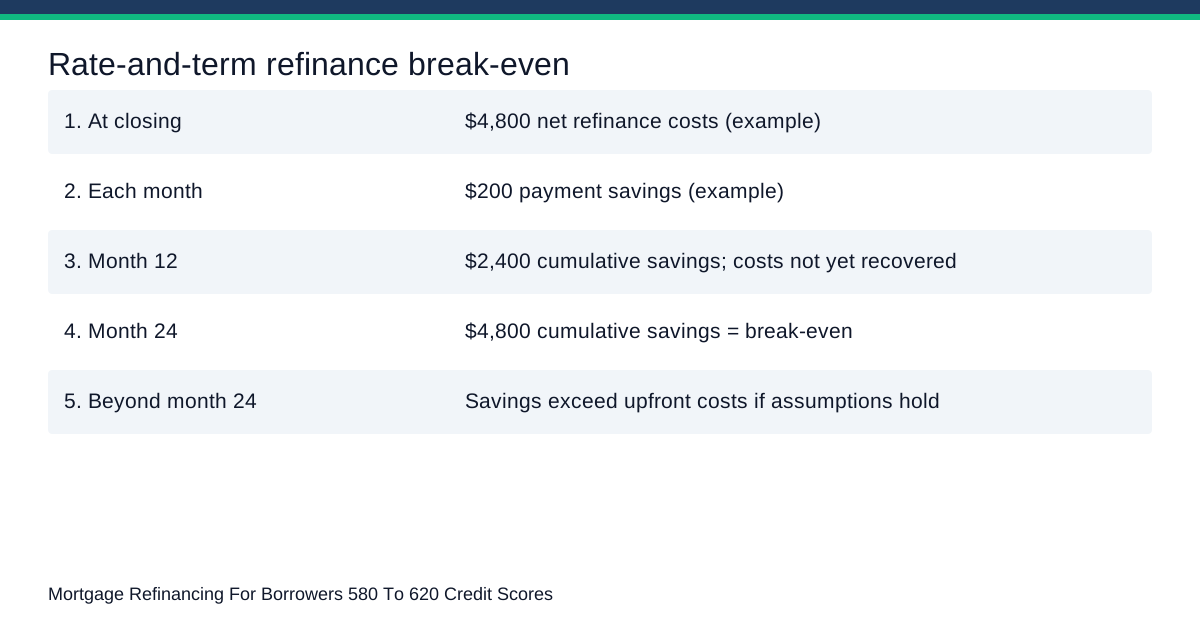
Consider a Rate-and-Term Refinance First
If you need cash from your equity, consider whether a rate-and-term refinance (which only changes rate and loan term, not principal balance) might be approved more easily, then accessing equity through a second mortgage or HELOC after establishing payment history.
Write a Strong Letter of Explanation
Your letter of explanation should be concise, honest, and focused on:
- Specific circumstances that led to credit challenges
- Steps you've taken to resolve those circumstances
- Why your current financial situation is stable
- How your high income ensures reliable payment
Make Additional Mortgage Payments Before Applying
Three to six months of on-time mortgage payments immediately before refinancing demonstrates current responsibility regardless of past credit issues. Some lenders weight recent payment history more heavily than older derogatory marks.
What to Expect: Timeline and Closing Costs
Refinancing with a 590 credit score typically takes longer than prime borrower applications due to additional documentation requirements and manual underwriting.
Expected Timeline
- Application to initial approval: 7-14 days
- Documentation requests and submission: 1-3 weeks
- Underwriting and conditional approval: 2-4 weeks
- Final approval to closing: 1-2 weeks
- Total timeline: 6-10 weeks on average
Closing Cost Breakdown
Typical closing costs for refinancing in 2026 range from 2% to 5% of the loan amount:
On a $300,000 refinance ($6,000-$15,000 total):
- Origination fee: $1,500-$3,000
- Appraisal: $500-$800
- Credit report: $30-$100
- Title search and insurance: $1,500-$3,000
- Attorney fees (where required): $500-$1,500
- Recording fees: $125-$300
- Prepaid interest: $500-$1,200
- Escrow setup: $2,000-$4,000
- FHA upfront MIP (if applicable): $5,250
Frequently Asked Questions
A: Recent late payments make approval more challenging but not impossible. Most lenders require at least 12 months without late mortgage payments, though some FHA lenders accept 6 months of on-time payments if you can document extenuating circumstances for the late payments and demonstrate that those circumstances have been resolved. Your high income and strong payment history since the late payments strengthen your case.
Q: Will refinancing with 590 credit hurt my credit score further?
A: The refinance process typically causes a temporary 5-15 point credit score decrease due to the hard inquiry and potential increase in credit utilization when your old mortgage closes and the new one reports. However, making on-time payments on your new loan helps rebuild your score over 6-12 months. The long-term benefits of lower payments or better terms generally outweigh the temporary score impact.
Q: How much income do I need to refinance with a 590 credit score?
A: There's no specific income threshold, but you need sufficient income to maintain a debt-to-income ratio below 43-50% (depending on the loan program). For example, if your total monthly debts including the new mortgage payment are $3,000, you'd need at least $6,000-$7,000 in gross monthly income ($72,000-$84,000 annually). Higher income relative to your debts significantly improves approval odds.
Q: Should I wait to refinance until my credit score improves to 620 or higher?
A: This depends on your current interest rate and how quickly you can improve your score. If you're currently paying 8.5%+ and can refinance to 7.5-7.75% with a 590 score, the immediate savings might justify refinancing now rather than waiting 6-12 months for score improvement. Calculate the total savings of refinancing now versus waiting, accounting for both the rate difference and potential closing costs.
Q: What's the difference between FHA streamline and FHA cash-out refinancing for 590 credit borrowers?
A: FHA streamline refinancing requires minimal documentation, no appraisal in most cases, and focuses on reducing your payment; it's available only if you currently have an FHA loan. FHA cash-out refinancing requires full income documentation, an appraisal, and allows you to access equity; it's available whether you currently have an FHA or conventional loan. Both accept 580+ credit scores, but streamline refinancing typically offers easier approval and lower costs if you don't need cash out.
Take the Next Step Toward Refinancing With 590 Credit and High Income
Understanding how to qualify for refinance with 590 credit and high income puts you ahead of most borrowers in your credit range. Your strong earnings provide significant leverage in the refinancing process, opening doors to FHA, VA, and portfolio lending programs that recognize the complete financial picture beyond credit scores alone.
The refinancing landscape in 2026 offers more options for borrowers in the 580-620 credit range than ever before, particularly when you can demonstrate income stability, manageable debt-to-income ratios, and commitment to responsible homeownership.
Don't let your current credit score convince you that refinancing is out of reach. Specialized lenders understand that life circumstances affect credit scores, and they evaluate applications based on your ability to make payments moving forward, not just your credit history.
Ready to explore your refinancing options? Request your free, no-obligation refinance consultation today. Our lending specialists work with multiple lenders who specifically serve borrowers with 580-620 credit scores, and we'll help you compare offers, understand your true costs, and navigate the application process from start to finish. Get your personalized rate quote in minutes and discover how much you could save by refinancing with your high income as a compensating factor.
Frequently Asked Questions
Can I refinance with a 590 credit score and high income?
Yes, refinancing is possible with a 590 credit score if you have high income. Government programs like FHA Streamline or VA IRRRL accept scores as low as 580. Your high income improves your debt-to-income ratio, making you less risky to lenders. Portfolio lenders may also approve based on your full financial picture.
What refinance options are available for a 590 credit score?
Options include FHA Streamline Refinance for existing FHA loans, FHA Cash-Out Refinance (requires 580+ score), VA IRRRL for eligible veterans, and portfolio loans from lenders who consider compensating factors like high income and equity. Conventional loans typically require 620 or higher.
How does high income help with refinancing at a 590 credit score?
High income lowers your debt-to-income ratio, showing lenders you can afford payments despite a lower credit score. It serves as a compensating factor, allowing lenders to approve loans they might otherwise deny. Strong income also demonstrates stability and reduces perceived risk.
What documentation do I need to refinance with a 590 credit score and high income?
You'll need proof of income (pay stubs, tax returns, bank statements), identification, and details about your current mortgage. For FHA loans, additional documents like a certificate of eligibility may be required. Lenders may also ask for a letter explaining your credit situation and evidence of assets.
Key Takeaways
- Understanding your options for how to qualify for refinance with 590 credit and high income is the first step
- Getting pre-qualified helps you understand your real options