Compare Live Mortgage & Home Equity Rates
Compare current APRs, points, fees, and estimated monthly payments from participating lenders below.
Mortgage rates
Quick answer: For most borrowers with a 580–620 credit score in 2026, the most accessible and competitive path is an FHA-approved online non-bank lender or a mortgage broker with wholesale FHA and VA access — these provider types consistently operate with the lowest lender overlays and the widest rate competition for this credit tier. The core trade-off is that online lenders offer speed and transparency but limited personal guidance, while brokers provide expert navigation across multiple lenders at the cost of broker compensation baked into your rate or fees. Borrowers with an existing FHA or VA loan should prioritize specialty government-loan lenders or the VA IRRRL channel before approaching conventional providers, which typically impose a hard 620 minimum that disqualifies most of this segment outright.
How We Evaluate & Compare Provider Options
This guide is built on published lending guidelines, regulatory disclosures, and industry data — not fabricated first-person loan testing or secret rate databases. Because mortgage rates change daily and individual lender pricing is proprietary, we do not quote specific current rates. Instead, we analyze the durable structural characteristics of each provider type that matter most when your credit score sits between 580 and 620. The criteria used throughout this comparison are:
- Published minimum credit score requirements: Drawn from HUD's FHA Single Family Housing Policy Handbook (4000.1), Fannie Mae Selling Guide, the VA Lender Handbook, and individual lender disclosures. Federal agency floors are the starting point; lender overlays are the real filter.
- Overlay prevalence: Research published by the Urban Institute's Housing Finance Policy Center has documented that lender overlays disproportionately affect borrowers in the 580–640 credit range, creating a wider gap between the regulatory floor and effective approval rates than at any other credit tier.
- Loan program breadth: Whether the provider type offers FHA, VA, USDA, FHA Streamline, and conventional refinance alongside one another. For 580–620 borrowers, program access often matters more than rate by a fraction of a point.
- Rate competitiveness for this credit tier: The CFPB's mortgage-shopping research confirms that rate spreads widen significantly at lower credit scores. Getting three to five quotes from different provider types is the single highest-ROI action a 580–620 borrower can take — typically more impactful than any individual lender choice.
- Typical close timeline: Based on industry data published by ICE Mortgage Technology in its Origination Insight Reports, which aggregate close times by lender type and loan program.
- Consumer protection framework: Whether the provider type is subject to RESPA, TILA-RESPA Integrated Disclosure (TRID), Ability-to-Repay (ATR/QM) rules, and CFPB oversight — all of which apply to licensed lenders and brokers regardless of provider type.
At-a-Glance: Refinancing Provider Types for 580–620 Credit Scores (2026)
| Provider Type | Typical Min. Credit Score | Key Loan Programs | Avg. Close Time | Best For (580–620 Borrowers) | Primary Limitation |
|---|---|---|---|---|---|
| Traditional Retail Bank | 620+ (conventional); 580+ only if bank is FHA-approved with low overlays | Conventional, FHA, VA (varies by institution) | 35–50 days | Existing relationship discount; in-person service preference | High overlays common; many banks decline FHA applications below 620 |
| Credit Union | 580–600+ for agency; lower possible for portfolio loans held in-house | Conventional, FHA, in-house portfolio | 30–50 days | Members with strong compensating factors; portfolio flexibility | Membership eligibility required; FHA/VA origination varies by credit union |
| Online Non-Bank Lender | 580+ (FHA/VA); 620+ (conventional) — overlays vary by lender | FHA, VA, conventional, jumbo | 21–30 days | Fastest close; FHA accessibility at 580; rate transparency tools | Less personalized guidance; overlay floors differ widely between lenders |
| Mortgage Broker | 580+ via wholesale FHA/VA channels; broker shops on your behalf | FHA, VA, USDA, conventional, non-QM | 30–45 days | Complex or borderline profiles; simultaneous multi-lender shopping | Broker compensation adds cost; quality varies — verify NMLS license |
| FHA/VA Specialty Lender | 500+ (FHA); no official VA floor — overlays as low as 550 | FHA, FHA Streamline, VA IRRRL, VA cash-out | 21–35 days | Lowest credit tier (500–580); existing FHA/VA streamline refinances | Limited to government-backed programs; FHA MIP is a permanent cost above 90% LTV |
Compared Provider Options
1. Traditional Retail Bank
Large retail banks originate both conventional and government-backed loans, but the 580–620 credit segment faces two structural hurdles with this provider type. First, Fannie Mae's published Selling Guide sets a hard 620 minimum FICO for conventional refinances — a borrower at 619 is categorically ineligible, regardless of payment history, assets, or income. Second, most major banks impose lender overlays on their FHA lending that push the effective floor to 620–640, well above HUD's published 580 minimum. A bank may technically "offer FHA loans" while simultaneously declining every FHA application below 620.
When considering how to choose the right mortgage refinancing provider, you should understand all available options.
Pros: If you already hold a checking, savings, or investment account at the institution, relationship pricing discounts — typically 0.125–0.25 percentage points off origination fees — are documented in published bank programs. Banks are federally regulated and subject to CFPB, OCC, and FDIC oversight. In-person branch access is a genuine advantage for borrowers who prefer face-to-face document review.
Cons: Overlay policies eliminate many 580–619 applicants before underwriting review even begins. Processing through centralized queues typically extends close timelines to 35–50 days. Rate competitiveness in the sub-620 tier is generally weaker than wholesale channels because retail pricing carries higher distribution costs.
Best fit: Borrowers at exactly 619–620 with a longstanding institutional relationship, low debt-to-income ratios, and substantial assets who can leverage a loyalty pricing discount and prefer in-person guidance.
Check your refinancing options — get a free, no-obligation quote in minutes.
2. Credit Union
Credit unions are member-owned, nonprofit financial cooperatives. Their structural advantage for 580–620 borrowers lies in two characteristics absent from commercial banks: a mission orientation toward member financial wellbeing that can translate into more flexible manual underwriting, and the ability to hold mortgage loans in their own portfolio rather than selling them to Fannie Mae or Freddie Mac. A portfolio loan isn't subject to agency credit score minimums — a credit union underwriting from its own balance sheet can approve a 595-score borrower that any agency-eligible lender would decline.
Pros: Nonprofit structure historically produces lower origination fees and competitive rates. Portfolio lending flexibility is real — particularly for members with strong compensating factors like long-tenured employment, low DTI, or substantial reserve assets despite the lower credit score. Member service satisfaction rates consistently exceed those of large banks in J.D. Power surveys.
Expert Tip
Compare Loan Estimates for the same loan type and term. Include closing costs when calculating whether refinancing saves money.
Cons: Membership eligibility — tied to employer, geography, military affiliation, or association — limits access. Smaller credit unions frequently lack FHA or VA origination infrastructure, narrowing program options. Online application technology often lags behind fintech-built lenders, extending processing timelines.
Best fit: Current credit union members who have a relationship with the institution, compensating factors that reward manual underwriting, and scores in the 590–620 range where portfolio flexibility offers a real path unavailable through agency lending.
3. Online Non-Bank Lender
Online mortgage lenders — a category including large-volume originators that process tens of thousands of government-backed loans monthly — have become a primary channel for FHA refinancing at the 580+ credit score tier. Their high origination volume of FHA loans produces institutional expertise in FHA underwriting guidelines that retail bank branches with lower FHA volume often lack. Published FHA guidelines permit lenders to approve borrowers with scores as low as 580 at 96.5% LTV (requiring 3.5% equity). Some online lenders adhere closely to this floor; others impose overlays at 600 or 620.
The critical variable is the specific lender's overlay policy — and it varies substantially between major online lenders. Asking "What is your FHA refinance minimum credit score?" before authorizing a hard inquiry is not optional for this borrower segment. A hard inquiry typically affects your score by approximately 5 points, though FICO groups all mortgage inquiries within a 45-day window as a single inquiry — a protection designed specifically to encourage rate shopping.
Pros: Fastest documented close times in the industry — 21–30 days is achievable for well-documented files. Rate-lock portals and digital document systems reduce friction. Competitive pricing in the FHA segment because high origination volume creates operational efficiency. Best-in-class for straightforward FHA refinances at 580–620.
Cons: Customer service is process-driven rather than advisory. Automated underwriting may underweight compensating factors that a manual review would credit. Overlay policies differ between lenders and are not always disclosed upfront.
Best fit: Borrowers with a score of 580+ who have stable, documentable employment income, sufficient equity, and a straightforward financial profile who prioritize closing speed and rate competitiveness over hand-holding through the process.
See if you qualify — check your refinance eligibility in under 3 minutes.
4. Mortgage Broker
A mortgage broker is a licensed intermediary who submits your application to wholesale lenders on your behalf. For the 580–620 credit tier, this structure offers a structural advantage unavailable from any single direct lender: the ability to simultaneously identify which wholesale lenders currently operate with the lowest overlays for your specific score. A broker who specializes in government-backed lending will maintain an overlay matrix across their wholesale lender panel — knowing, for instance, that Lender A approves FHA refinances at 580 while Lender B requires 620, a distinction that determines whether your application is approved or declined.
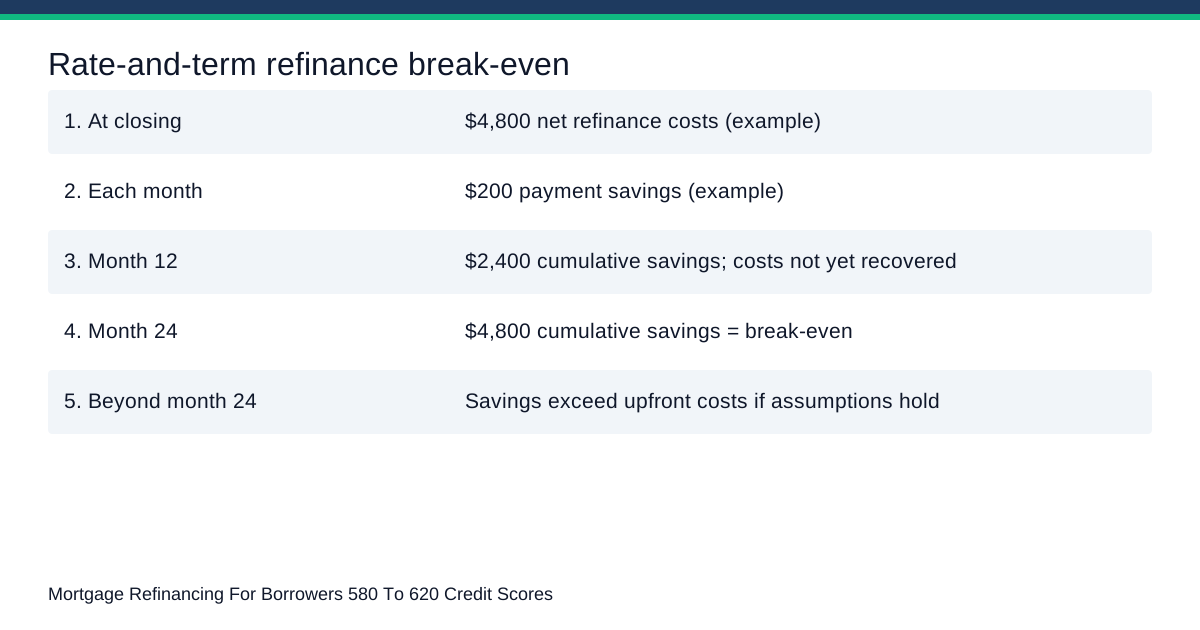
Under RESPA, brokers are compensated through either lender-paid compensation (built into your rate) or borrower-paid compensation — never both on the same transaction. This compensation is a real cost that must be factored into APR comparisons. The net economics depend on how competitive the wholesale rate is relative to retail alternatives.
Pros: Exceptional value for non-standard profiles, borderline credit scores, or complex income situations. Access to FHA, VA, USDA, conventional, and non-QM products through a single application. Brokers who specialize in this credit tier know which lenders approve applications others reject. A single hard inquiry on your file generates quotes from multiple lenders.
Cons: Broker quality varies enormously — an inexperienced broker may submit to lenders unlikely to approve your profile, wasting time during a rate-lock window. Broker compensation must be factored into total cost. Always verify the broker's license and disciplinary history through the NMLS Consumer Access portal before sharing financial information.
Best fit: Borrowers with complicating factors — self-employment income, recent credit events, non-standard employment — or scores in the 580–600 band where mainstream lenders consistently impose overlays that make direct applications inefficient.
5. FHA/VA Specialty Lender
Specialty lenders whose entire origination volume consists of FHA and VA loans have structural advantages that general lenders lack for this program set: lower overlays, deeper underwriting expertise in FHA guidelines, and familiarity with the compensating factors HUD permits when approving borderline applications. HUD's FHA Handbook 4000.1 explicitly lists compensating factors — including a verified 12-month payment history with no late payments, significant cash reserves, or minimal housing expense increase — that can support approval below typical overlay thresholds at lenders experienced with them.
For borrowers who already have an FHA loan, the FHA Streamline Refinance is the most relevant program in 2026: it requires no new appraisal, no income verification in most cases, and — per HUD guidelines — no minimum credit score (though individual specialty lenders may still apply an overlay, typically 580). For veterans with existing VA loans, the VA Interest Rate Reduction Refinance Loan (IRRRL) similarly has no official VA credit score floor and requires no appraisal or income verification in most cases.
Pros: Lowest effective credit score floor for government-backed programs; deepest expertise in FHA and VA underwriting; willingness to apply compensating factors consistently. FHA Streamline and VA IRRRL can close in 21–35 days with minimal documentation for eligible borrowers.
Cons: Product range is narrow — if you need a conventional refinance, cash-out above FHA loan limits, or a non-agency product, you will need to look elsewhere. FHA MIP (currently 0.55% annually per HUD's 2023 reduction, plus 1.75% upfront) is a permanent cost if LTV exceeds 90% at closing — a meaningful ongoing expense that does not exist on conventional loans above 20% equity.
Best fit: Borrowers with existing FHA or VA loans pursuing streamline refinances; veterans eligible for the VA IRRRL; borrowers with scores in the 500–595 range who need maximum flexibility on credit requirements.
What Matters Beyond the Headline Numbers
Lender Overlays: The Hidden Filter Most Borrowers Miss
The single most important concept for a 580–620 borrower to understand before applying anywhere is the lender overlay. HUD sets the FHA minimum at 580 for maximum financing. But lenders are legally permitted — and commonly choose — to require higher scores. These overlays can sit anywhere from 600 to 660, meaning a borrower with a 595 score may be rejected by eight lenders and approved by a ninth — all of whom technically "offer FHA loans." Asking the overlay question directly ("What is your minimum credit score for an FHA refinance?") before authorizing a hard inquiry is not optional. It is the most credit-protective and time-saving step available to this borrower segment.
Annual Percentage Rate vs. Interest Rate: The Comparison That Actually Matters
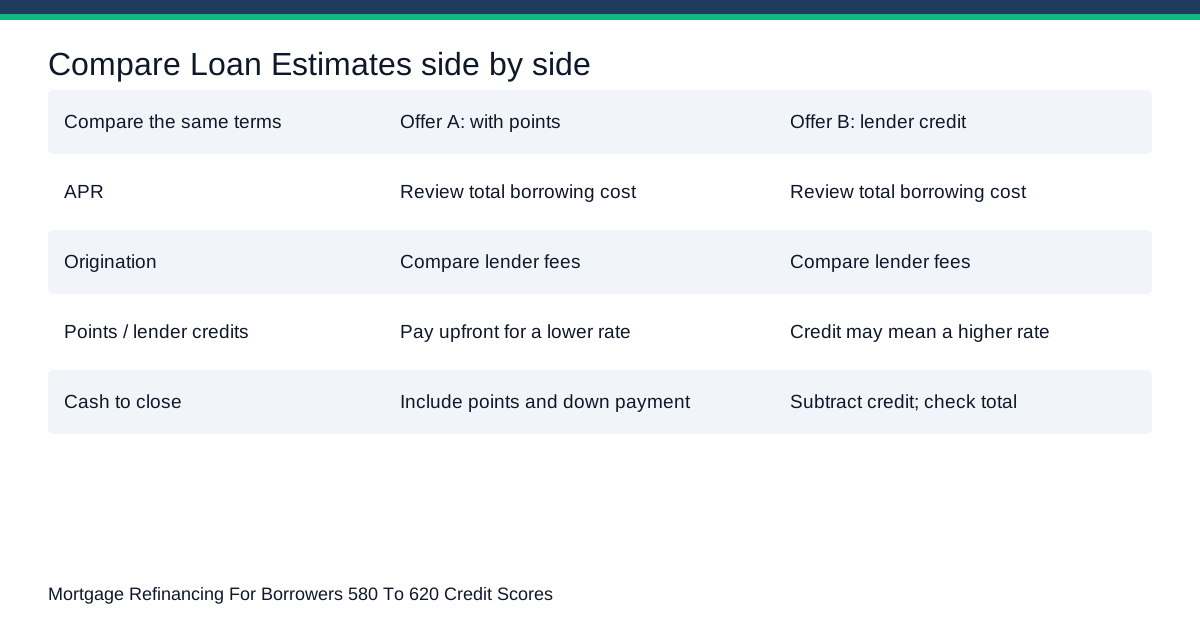
For 580–620 borrowers, the gap between advertised rate and true APR can be deceptively wide. Origination fees, discount points, and closing costs vary significantly between provider types. A specialty lender quoting 7.1% with $4,200 in points may be materially less competitive than an online lender at 7.35% with $900 in origination fees, depending on your planned hold period. The CFPB's Loan Estimate form — which every licensed lender must provide within three business days of a full application — standardizes these costs in a single comparable format. Compare APRs on Loan Estimates issued on the same day for the same loan amount and program. No standardized comparison exists before the Loan Estimate stage.
Debt-to-Income Ratio as a Parallel Qualification Gate
Credit score is not the only underwriting constraint for this borrower segment. For FHA loans, the standard back-end DTI limit is 43%, though HUD's guidelines allow up to 57% with documented compensating factors entered into FHA's TOTAL Scorecard. Conventional loans through Fannie Mae's Desktop Underwriter can technically approve up to 50% DTI but typically only for credit scores above 640. A 610-score borrower with a 47% DTI may qualify for FHA where conventional rejects — making the choice of provider type partly determined by DTI math, not credit score alone. Knowing your current DTI before beginning provider outreach prevents wasted applications.
Rate Lock Terms and Float-Down Options
In volatile interest rate environments, the rate lock terms offered by your chosen provider have real financial value. Standard locks run 30–45 days; extended locks of 60–90 days are available from most lender types at a fee (typically 0.125–0.25% of the loan amount, though these fees are lender-specific and should be confirmed in writing). Some specialty lenders and brokers offer float-down provisions — the ability to capture a rate improvement after locking — for a fee or as a standard product feature. For 580–620 borrowers whose applications require more processing time due to documentation complexity, extended locks reduce close-date risk and deserve a specific line of inquiry during provider evaluation.
Authoritative Guidance & Official Standards
- CFPB Explore Interest Rates Tool — The Consumer Financial Protection Bureau's interactive rate explorer shows how credit score ranges and loan types shift rate levels. Demonstrates concretely why 580–620 borrowers pay more and why shopping multiple provider types is the highest-value action available.
- HUD FHA Lender Resources & Origination Guidelines — HUD's official framework for FHA origination, including the published 580 credit score floor for 96.5% LTV financing and the 500–579 range requiring 10% down. Lender overlays are applied above, not below, these federally published standards.
- CFPB: What Is a Mortgage Broker? — Authoritative CFPB explanation of broker compensation rules under RESPA, the prohibition on dual compensation, and what borrowers should verify before engaging a broker intermediary.
- VA Interest Rate Reduction Refinance Loan (IRRRL) — VA.gov — The official VA resource on IRRRL program requirements, no-appraisal and no-income-verification provisions, VA funding fee schedules, and the full waiver available to veterans with service-connected disability ratings.
- FTC: Mortgage Discrimination — Federal Trade Commission guidance on Equal Credit Opportunity Act (ECOA) and Fair Housing Act protections. A credit score denial is legal; a denial based on protected class characteristics is not. This resource documents the distinction and borrower recourse.
- NMLS Consumer Access — License Verification Portal — The Nationwide Multistate Licensing System's public portal for verifying that any mortgage lender, broker, or loan officer is currently licensed in your state and has no adverse regulatory actions. Checking this before submitting an application is a non-negotiable due diligence step.
Questions to Answer Before Deciding (FAQ)
What credit score do I actually need to refinance a mortgage in 2026?
The credit score needed to refinance depends on the loan type and the specific lender's overlay policy. For a conventional refinance through Fannie Mae or Freddie Mac, the published minimum is 620 — a single point below disqualifies you from this program regardless of other strengths. For an FHA refinance, HUD's published minimum is 580 for maximum financing (96.5% LTV); scores between 500–579 are eligible but require 10% equity. The VA IRRRL has no official federal credit score minimum, though most VA lenders impose overlays between 550 and 620. The FHA Streamline Refinance has no HUD-mandated minimum score for borrowers refinancing an existing FHA loan, though individual lenders still apply overlays, commonly at 580. In practice, the credit score you need is the minimum of the specific lender you apply to — which is why asking about overlays before applying is essential.
How many lenders should I get quotes from before choosing?
CFPB research consistently shows that borrowers who receive four or more Loan Estimates save meaningfully on both origination costs and rates relative to those who gather one or two. For the 580–620 segment specifically, this matters more than at any other credit tier because rate spreads for lower credit scores are wider — the gap between the highest and lowest APR offered for the same loan can exceed 0.5–0.75 percentage points across provider types. FICO's mortgage inquiry deduplication rule groups all mortgage hard inquiries within a 45-day window into a single inquiry event — meaning shopping five lenders in 30 days costs you roughly the same 5-point impact as shopping one. Use the full window aggressively.
What is a lender overlay, and how do I find out if a lender has one before applying?
A lender overlay is an internal underwriting policy that requires a higher credit score — or stricter qualification criteria — than the federal agency guideline. Overlays are not publicly listed in advertising disclosures or rate sheets. The only way to know is to ask directly before authorizing a hard pull: "For an FHA refinance, what is your minimum qualifying credit score, and does that change based on LTV or DTI?" A legitimate, reputable lender answers this question readily — it is basic product disclosure. Any lender who evades the overlay question while pressing for a hard inquiry authorization should be passed over. Mortgage brokers often have access to wholesale lender overlay matrices and can identify low-overlay options for your profile without requiring individual hard inquiries from each potential lender.
Is a mortgage broker more expensive than going directly to a lender?
Not necessarily — and for 580–620 borrowers, often the opposite. A broker's wholesale rate from their lender network is frequently lower than the retail rate a borrower would receive approaching the same lender directly, because wholesale channels carry lower distribution overhead than retail branches. Broker compensation — typically 0.5–2.25% of the loan amount, disclosed on the Loan Estimate under "Loan Costs" — is a real cost that narrows (but does not always eliminate) the wholesale pricing advantage. The net comparison depends on the specific rate and fee structure. For borderline credit profiles where broker expertise in identifying low-overlay wholesale lenders is the difference between approval and denial, the compensation cost is often secondary to the access the broker provides. Always compare APRs on same-day Loan Estimates — that is the only standardized basis for evaluating total cost across provider types.
What red flags should I watch for when evaluating a refinancing provider?
Five red flags are specific to the 580–620 borrower experience: (1) A lender who guarantees approval before reviewing documentation — legitimate lenders issue pre-qualifications contingent on verified information, not unconditional promises. (2) Any upfront fee requested before a Loan Estimate is issued — RESPA prohibits this except for a credit report fee, typically under $30. (3) Pressure to waive the three-day TRID waiting period before closing — this is a legal right, not a scheduling courtesy, and exists specifically to let you review final numbers against the Loan Estimate. (4) Rate quotes provided only verbally with no written Loan Estimate — oral quotes are not legally binding. (5) A lender or broker who cannot be verified on the NMLS Consumer Access portal. Legitimate mortgage professionals are licensed, regulated, and comfortable answering direct questions about overlays, compensation, and timeline.
Should a veteran always use a VA refinance option instead of FHA?
In the vast majority of cases, yes. The VA IRRRL for existing VA loans and the VA cash-out refinance for eligible veterans provide structural advantages that FHA rarely matches for the 580–620 credit tier: no monthly mortgage insurance (FHA MIP currently runs 0.55% annually on top of principal, interest, and taxes), no official VA credit score floor, and rates that are typically competitive even at lower credit tiers because the VA guarantee substantially reduces lender risk. The VA funding fee — 0.5% for an IRRRL, up to 3.3% for a subsequent cash-out refinance for most borrowers — is the primary cost consideration, and it is entirely waived for veterans with a service-connected disability rating. The only cases where FHA warrants comparison are when VA eligibility has been exhausted, when the property fails VA appraisal standards, or when a non-veteran co-borrower structure creates a specific VA program limitation.
Related Guides
- What Is a Good Credit Score for Refinancing a Mortgage? (2026 Guide) — Understand the score thresholds that unlock conventional, FHA, and VA programs, what moves the needle fastest for sub-620 borrowers, and the realistic timeline to reach a program-qualifying score.
- Mortgage Refinancing Cost & Pricing Guide 2026: What 580–620 Credit Score Borrowers Actually Pay — A detailed breakdown of closing costs, origination fees, FHA MIP calculations, and total cash-to-close expectations specifically benchmarked for the 580–620 credit tier.
The Bottom Line
For borrowers with 580–620 credit scores in 2026, choosing the right refinancing provider is not simply an exercise in finding the lowest advertised rate. It is a multi-step process of identifying which provider types will actually approve your application at a program-appropriate price, then competing them against one another within the 45-day FICO inquiry window to extract maximum rate and cost savings.
The decision hierarchy is clear: if you have an existing VA loan, start with VA-specialty lenders and the IRRRL channel — no other program offers comparable terms for this credit tier. If you have an existing FHA loan, the FHA Streamline path through an FHA-specialty lender eliminates appraisal and income verification friction. For all other 580–620 borrowers, the most effective first step is engaging a mortgage broker with a documented wholesale FHA panel or applying directly to two to three online non-bank lenders known to operate close to the HUD 580 floor — then comparing same-day Loan Estimates on APR, not rate alone.
Traditional banks and credit unions are worth including in your comparison only if you have an existing relationship that generates documented pricing advantages or if your profile benefits specifically from portfolio or manual underwriting flexibility.
The one non-negotiable: ask every provider about their specific FHA credit score overlay before authorizing a hard inquiry. That single question separates providers willing to work with your profile from those who will waste your time and trim your score in the process.
Ready to find your best refinancing match? Get a free consultation with no credit impact — our team works specifically with 580–620 credit score borrowers and can help you identify which provider types are actively approving applications in your credit range today.
Key Takeaways
- Understanding your options for how to choose the right mortgage refinancing provider is the first step
- Getting pre-qualified helps you understand your real options