Compare Live Mortgage & Home Equity Rates
Compare current APRs, points, fees, and estimated monthly payments from participating lenders below.
Mortgage rates
How Payment History Affects Refinance Approval With Fair Credit
Quick Answer: Your payment history is the most critical factor in refinance approval with fair credit (580–620). Lenders focus on your recent 12–24 months of on-time payments, especially mortgage payments. A strong recent record can improve approval odds, even with past credit issues, though you may face higher rates and stricter requirements.
If you're wondering how payment history affects refinance approval with fair credit, here's what you need to know: your payment history is the single most influential factor in mortgage refinancing decisions, accounting for approximately 35% of your credit score and serving as the primary indicator lenders use to assess risk. For borrowers with credit scores between 580 and 620, a strong recent payment history—typically 12 to 24 months of on-time payments—can significantly improve your chances of approval, even if past credit issues brought your score into the fair range. Lenders specifically examine your mortgage payment track record, installment loan history, and revolving credit management when evaluating refinance applications. The good news is that even borrowers in this credit range can qualify for refinancing, though you'll likely face higher interest rates and more stringent documentation requirements than those with excellent credit.
Understanding Fair Credit and Refinancing Eligibility
Fair credit, generally defined as FICO scores between 580 and 669, places you in a challenging but not impossible position for mortgage refinancing. The 580 to 620 range specifically represents the lower tier of fair credit, where lenders view you as a higher-risk borrower but not subprime.
Approximately 16% of Americans fall into this credit category, and many successfully refinance their mortgages each year. The key differentiator isn't just your score—it's the story behind that score, and payment history tells the most important chapter.
What Lenders See in Your Payment History
When you apply for refinancing with a credit score between 580 and 620, underwriters conduct a comprehensive review of your payment patterns across all credit accounts. They're looking for:
- Mortgage payment consistency: Zero late payments in the past 12 months is ideal; one 30-day late payment may be acceptable with strong compensating factors
- Revolving credit behavior: Credit cards and lines of credit demonstrate your ability to manage ongoing obligations
- Installment loan performance: Auto loans, student loans, and personal loans show how you handle fixed-payment obligations
- Recent trends: Improvement in payment behavior carries significant weight, even if older derogatory marks exist
The 35% Rule: Why Payment History Dominates Your Application
Payment history comprises 35% of your FICO score calculation, making it the largest single component. For context, amounts owed accounts for 30%, length of credit history 15%, new credit 10%, and credit mix 10%.
This weighting means that even if you have high credit utilization or limited credit history, consistently on-time payments can partially offset those weaknesses. Conversely, even modest payment issues can drag down an otherwise healthy credit profile.
How Late Payments Are Categorized
Lenders classify payment delinquencies in escalating severity:
- 30 days late: Considered a minor negative; may not disqualify you if isolated
- 60 days late: More serious concern; typically requires written explanation
- 90+ days late: Major derogatory mark; can be disqualifying for conventional refinancing
- Charge-offs/collections: Severe negative items that significantly impact approval odds
Refinancing Options for Borrowers With 580 to 620 Credit Scores
Multiple refinancing pathways exist for borrowers in this credit range, each with different payment history requirements and cost structures.
Expert Tip
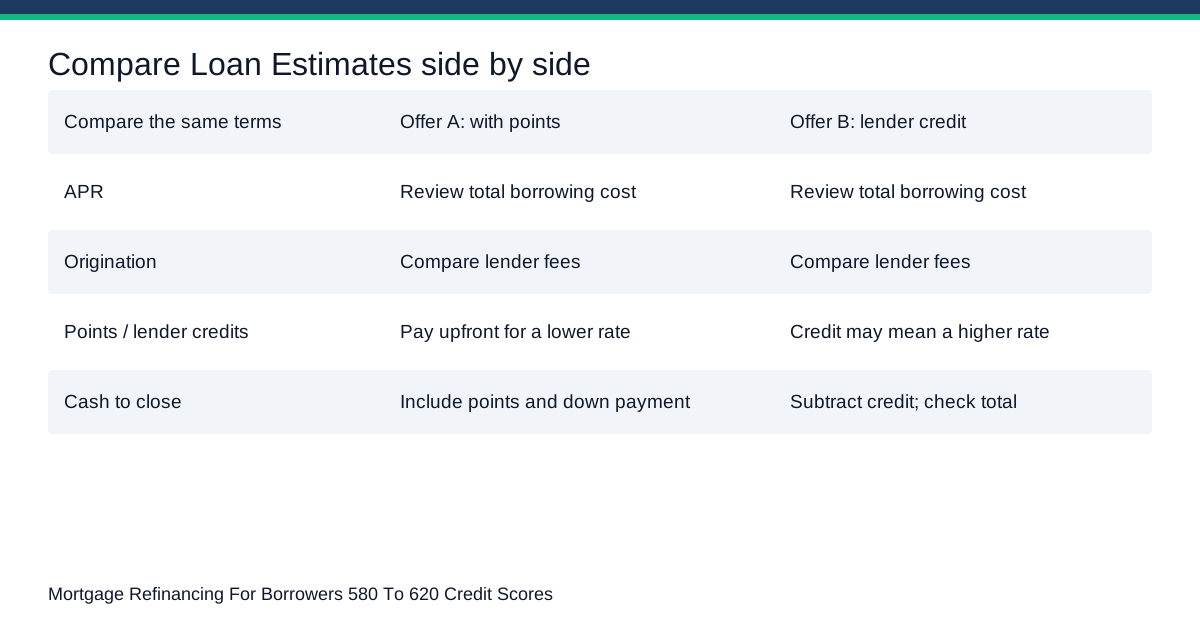
Compare Loan Estimates for the same loan type and term. Include closing costs when calculating whether refinancing saves money.
FHA Streamline Refinance
If your current mortgage is FHA-insured, the FHA Streamline Refinance program offers the most accessible option. Key features include:
- Minimum credit score: 580 (some lenders may require 600+)
- Payment history requirement: No mortgage late payments in the past 12 months
- No appraisal required in most cases
- Reduced documentation compared to conventional refinancing
- Closing costs: $2,800 to $5,500 depending on loan amount and location
FHA Cash-Out Refinance
For borrowers needing to extract equity, FHA cash-out refinancing allows credit scores as low as 580 with specific payment history criteria:
- No mortgage late payments in past 12 months
- Maximum two 30-day late payments on any credit account in past 12 months
- Appraisal required
- Debt-to-income ratio typically capped at 43% to 50%
- Closing costs: $4,200 to $8,500 for typical loan amounts
VA Interest Rate Reduction Refinance Loan (IRRRL)
Military service members and veterans with existing VA loans have access to the IRRRL program, which offers exceptional flexibility:
- No minimum credit score requirement at the VA level (lender overlays typically require 580+)
- Payment history: No more than one 30-day late mortgage payment in past 12 months
- No appraisal required
- Funding fee: 0.5% of loan amount (can be financed)
- Closing costs: $2,200 to $4,800
Conventional Refinancing
Conventional refinancing remains challenging for borrowers with 580 to 620 credit scores, but not impossible. Requirements include:
- Minimum credit score: 620 for most lenders (some portfolio lenders may go to 600)
- Payment history: Pristine 12-month mortgage payment record; minimal late payments on other accounts
- Higher down payment/equity requirements: typically 20%+ to avoid PMI
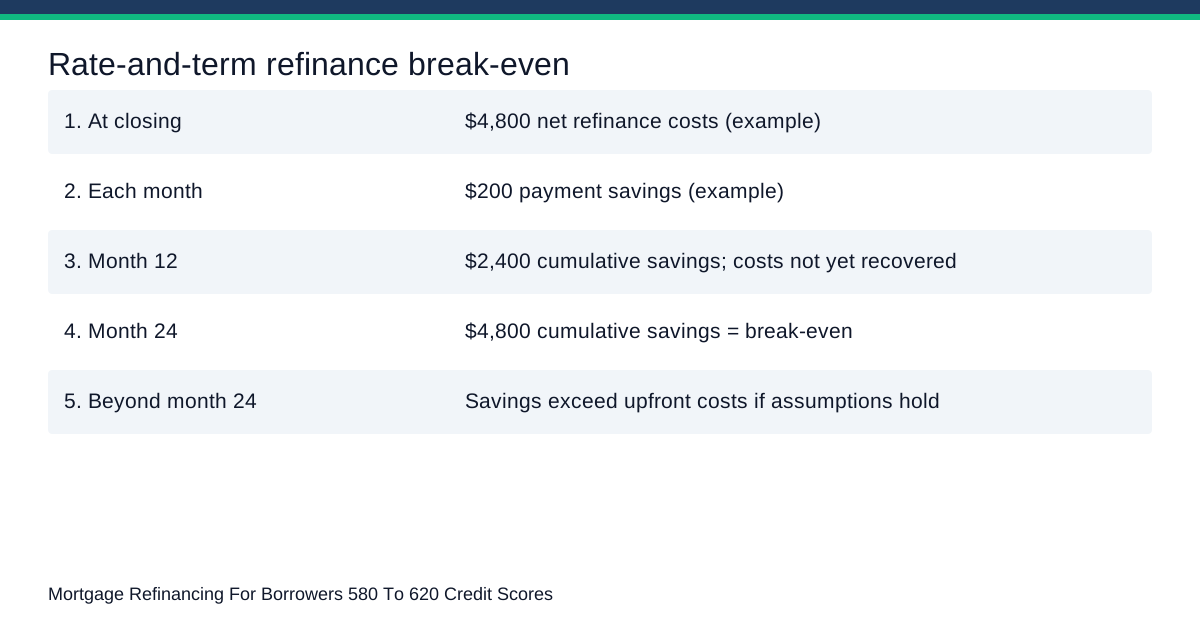
- Closing costs: $3,500 to $7,200
- Interest rates: 7.25% to 9.00% in this credit range
The Refinancing Process: Timeline and Documentation
Understanding how lenders evaluate payment history during the refinance process helps you prepare and position your application optimally.
Step 1: Pre-Qualification (Days 1-3)
Initial assessment of your credit profile, including preliminary credit report review. Lenders will immediately identify major payment history issues and advise whether to proceed.
Step 2: Formal Application (Days 3-7)
Complete application submission with authorization for comprehensive credit review. Lenders pull full credit reports from all three bureaus and begin detailed payment history analysis.
Step 3: Documentation Submission (Days 7-14)
You'll provide:
- 24 months of mortgage payment history (statements or cancelled checks)
- Explanation letters for any late payments
- Recent pay stubs (typically 30 days)
- Two years of tax returns
- Two months of bank statements
- Documentation of additional income sources
Step 4: Underwriting Review (Days 14-35)
Underwriters conduct detailed analysis of your payment patterns, specifically examining:
- Month-by-month payment timeliness across all credit accounts
- Causes of any derogatory marks
- Evidence of improved financial management
- Compensating factors (stable employment, cash reserves, reduced debt-to-income ratio)
Step 5: Conditional Approval and Closing (Days 35-45)
Final verification of payment history, ensuring no new late payments have occurred during processing. Average total timeline: 30 to 45 days for straightforward applications.
Strategies to Improve Approval Odds With Fair Credit
If you're in the 580 to 620 credit range and considering refinancing, these strategies can strengthen your payment history profile:
Establish a 12-Month Perfect Payment Record: Before applying, commit to 12 consecutive months of on-time payments on all accounts. This demonstrates rehabilitation and dramatically improves approval probability.
Prepare Detailed Explanations: Written explanations of past payment issues that include specific circumstances, what's changed, and evidence of stability carry substantial weight with underwriters. Medical emergencies, temporary job loss, or divorce are commonly accepted explanations when accompanied by documentation.
Document Income Stability: Consistent employment history and stable income offset payment history concerns. Two or more years with the same employer strengthens your profile significantly.
Reduce Debt-to-Income Ratio: Paying down revolving balances and eliminating small installment loans before applying demonstrates financial discipline and improved money management.
Build Cash Reserves: Having three to six months of mortgage payments in savings shows lenders you have a buffer against future payment disruptions, compensating for past payment issues.
Consider a Co-Borrower: Adding a creditworthy co-borrower with strong payment history can tip the scales toward approval, though this obviously affects ownership and liability.
Cost Comparison: Refinancing With Fair Credit vs. Good/Excellent Credit
Understanding the financial impact of your credit score helps you make informed decisions about refinancing timing and strategy.
| Credit Score Range | Typical Interest Rate (2026) | Monthly Payment on $250,000 30-Year Mortgage | Total Interest Paid Over 30 Years | Rate Difference vs. Excellent Credit |
|---|---|---|---|---|
| 580-620 (Fair) | 7.50% - 8.25% | $1,748 - $1,879 | $379,280 - $426,440 | +1.75% - 2.50% |
| 621-680 (Fair/Good) | 6.75% - 7.25% | $1,622 - $1,704 | $333,920 - $363,440 | +1.00% - 1.50% |
| 681-740 (Good) | 6.25% - 6.75% | $1,539 - $1,622 | $304,040 - $333,920 | +0.50% - 1.00% |
| 741+ (Excellent) | 5.75% - 6.25% | $1,459 - $1,539 | $275,240 - $304,040 | Baseline |
This comparison illustrates that a borrower with 600 credit might pay $289 to $420 more monthly compared to someone with excellent credit—$104,040 to $151,200 additional interest over the loan term. However, refinancing can still make financial sense if you're reducing your current rate significantly or accessing needed equity.
How Payment History Affects Refinance Approval With Fair Credit: Long-Term Perspective
Understanding how payment history affects refinance approval with fair credit extends beyond your immediate application. The relationship between payment behavior and refinancing eligibility creates a roadmap for financial improvement.
Each on-time payment builds equity in your creditworthiness. Borrowers who refinance with 580 to 620 credit scores and maintain perfect payment records often qualify for better terms through subsequent refinancing within 18 to 24 months as their scores improve.
This "stepping stone" approach—securing initial refinancing despite fair credit, then maintaining pristine payment history to qualify for better rates later—represents a practical strategy for many borrowers. The initial refinance, even at higher rates, provides breathing room through lower payments or debt consolidation, making it easier to maintain the perfect payment record needed for future improvement.
Frequently Asked Questions
Refinancing with a 590 credit score and recent late payments is extremely challenging but not impossible. FHA programs may accept applications with one 30-day late payment in the past 12 months if you have strong compensating factors like low debt-to-income ratio, substantial cash reserves, or significant equity. Late payments within the past six months typically require a six-month waiting period before approval. Your best strategy is working with a lender specializing in credit-challenged borrowers who can assess your complete financial picture.
How long do I need to wait after a 90-day late payment to refinance?
Most refinance programs require waiting 12 months after bringing a 90-day late payment current before approval. FHA guidelines specifically state that borrowers must demonstrate 12 months of on-time payments following significant derogatory events. Some portfolio lenders may consider applications after six months with exceptional compensating factors, but you'll face significantly higher interest rates. Conventional refinancing typically requires 24 months of distance from 90-day late payments for borrowers in the 580 to 620 credit range.
Does paying off collections improve my refinance approval chances?
Paying off collections can improve refinance approval odds, but the impact depends on timing and approach. Recent collections (less than 24 months old) should generally be paid before applying, as active collections raise red flags for underwriters. Older collections (more than two years) may have minimal impact on approval since lenders focus on recent payment behavior. Importantly, never pay collections without obtaining "pay for delete" agreements in writing, as paid collections without removal may not improve your score. Consult with your lender before paying old collections, as some programs ignore collections under specific dollar thresholds.
Will adding authorized user accounts help my refinance application with a 600 credit score?
Authorized user accounts can help refinance applications by adding positive payment history to your credit report, but lenders view them as less significant than primary account history. For maximum benefit, ensure authorized user accounts have: perfect payment history for at least 24 months, low utilization (under 30%), and substantial age (older accounts carry more weight). Some underwriters discount authorized user accounts entirely when evaluating payment history, focusing exclusively on accounts where you're the primary obligor. Use authorized user status as a supplementary strategy, not your primary approach to strengthening payment history.
Can I refinance if my spouse has poor payment history but I have good credit?
When applying jointly, lenders evaluate both applicants' credit profiles, and the lower credit score typically determines your interest rate and approval terms. If your spouse's poor payment history brings the combined application into the 580 to 620 range, you'll face the associated higher rates and stricter requirements. Alternative approaches include: applying solely in your name if income qualifies (spouse's income won't count), waiting until your spouse's payment history improves, or using your spouse's income through a non-purchasing spouse provision with careful documentation. Each scenario has trade-offs regarding qualification amount, interest rates, and legal ownership that require careful analysis with your lender.
Take the Next Step Toward Refinancing Approval
How payment history affects refinance approval with fair credit doesn't have to remain a mystery—or a barrier to achieving your financial goals. Even with credit scores between 580 and 620, refinancing remains within reach when you understand what lenders seek and position your application strategically.
Your payment history over the next 12 months matters more than your credit score from years past. Every on-time payment strengthens your position, and specialized refinance programs exist specifically for borrowers rebuilding credit.
Ready to explore your refinancing options? Our lending specialists work exclusively with borrowers in the fair credit range, matching you with programs designed for your specific situation. We'll review your complete payment history, identify the optimal refinance pathway, and provide realistic timelines and cost projections.
Request your free, no-obligation refinance consultation today. Within 24 hours, you'll receive a personalized assessment of your refinancing options, required documentation, estimated costs, and specific steps to strengthen your application. There's no cost for the consultation, no impact to your credit score, and no pressure—just clear answers about your refinancing possibilities.
Contact us now to discover how your payment history can work for you, not against you, in securing the refinancing approval and terms you deserve.
Frequently Asked Questions
How many months of on-time payments do lenders look for when refinancing with fair credit?
Lenders typically review the most recent 12 to 24 months of your payment history. A clean record during this period, especially for mortgage payments, can significantly strengthen your refinance application even if your credit score is between 580 and 620.
Can a 30-day late payment prevent refinancing with a 580 credit score?
A single 30-day late payment may not automatically disqualify you, but it can make approval harder. Lenders will evaluate the context, such as the recency and frequency of late payments. A strong compensating factor, like low debt-to-income ratio, can help offset this issue.
Does paying off collections improve payment history for refinancing?
Paying off collections does not remove the late payment history from your credit report, but it shows lenders you are resolving outstanding debts. This can be viewed positively, especially if combined with a recent pattern of on-time payments on current accounts.
How do lenders view a 90-day late payment from two years ago when refinancing?
A 90-day late payment from two years ago is a serious negative, but its impact diminishes over time. Lenders focus more on your recent payment behavior. If you have 12–24 months of on-time payments since then, your chances of approval improve, though you may still face higher rates.
Key Takeaways
- Understanding your options for how payment history affects refinance approval with fair credit is the first step
- Getting pre-qualified helps you understand your real options