Compare Live Mortgage & Home Equity Rates
Compare current APRs, points, fees, and estimated monthly payments from participating lenders below.
Mortgage rates
FHA Streamline Refinance Requirements for Low Credit Borrowers
Quick Answer: For borrowers with credit scores between 580 and 620, the FHA Streamline Refinance program offers a path to lower monthly payments without a credit check or appraisal, provided you have an existing FHA loan, a current payment history, and a net tangible benefit from the refinance.
If you have a credit score between 580 and 620 and currently hold an FHA mortgage, the FHA Streamline Refinance Requirements for Low Credit Borrowers offer one of the most accessible paths to lower your monthly payment. Unlike conventional refinancing, FHA Streamline refinances require no credit score verification in many cases, no appraisal, and minimal documentation. This program is specifically designed to help homeowners with less-than-perfect credit reduce their interest rates or monthly payments without the obstacles typically associated with traditional refinancing. Whether your credit has declined since your original purchase or you've maintained a borderline score, understanding these requirements can save you thousands of dollars over the life of your loan.
Understanding the FHA Streamline Refinance Program
The FHA Streamline Refinance program represents a unique opportunity in the mortgage industry, particularly for borrowers who fall within the 580-620 credit score range. The Federal Housing Administration created this program to encourage homeowners with existing FHA loans to take advantage of lower interest rates without enduring the rigorous qualification process required for new mortgages.
When considering fha streamline refinance requirements for low credit borrowers, you should understand all available options.
The fundamental principle behind FHA Streamline refinancing is simple: if you're already making payments on an FHA loan and those payments are current, you've already proven your creditworthiness to the FHA system. This means lenders can bypass many of the traditional underwriting requirements that might otherwise disqualify borrowers with credit scores in the 580-620 range.
There are two types of FHA Streamline refinances: credit-qualifying and non-credit-qualifying. For borrowers with lower credit scores, the non-credit-qualifying option is often the preferred route, as it completely eliminates the credit check requirement. However, even the credit-qualifying version maintains more lenient standards than conventional refinancing options.
Key Requirements for Borrowers with 580-620 Credit Scores
Payment History Requirements
Your payment history on your current FHA mortgage carries significantly more weight than your credit score in the Streamline program. To qualify, you must demonstrate:
- No mortgage payments more than 30 days late in the past 12 months
- No more than one 30-day late payment in the 12 months prior to that
- At least six months of established payment history on your current FHA loan
- Current payment status at the time of application
Waiting Periods and Timing
The FHA has established specific timing requirements that you must meet:
- Your current FHA loan must have been endorsed at least 210 days prior to the new loan application
- At least six monthly payments must have been made on the existing mortgage
- At least 210 days must have passed since the first payment due date
Net Tangible Benefit Requirement
Perhaps the most important requirement is demonstrating a "net tangible benefit" from the refinance. This protects borrowers from predatory refinancing practices. The benefit must include one of the following:
- Reduction in monthly principal and interest payment by at least 5% when refinancing to another fixed-rate mortgage
- Reduction in interest rate when refinancing from a fixed-rate to an adjustable-rate mortgage
- Reduction in monthly payment when refinancing from an ARM to a fixed-rate product (regardless of percentage)
- Movement from an ARM to a fixed-rate mortgage that increases stability
Cost Breakdown: What to Expect When Refinancing
Understanding the costs associated with FHA Streamline refinancing helps you make informed decisions about whether the program makes financial sense for your situation. Here's a comprehensive breakdown of expected costs in 2026:
Expert Tip
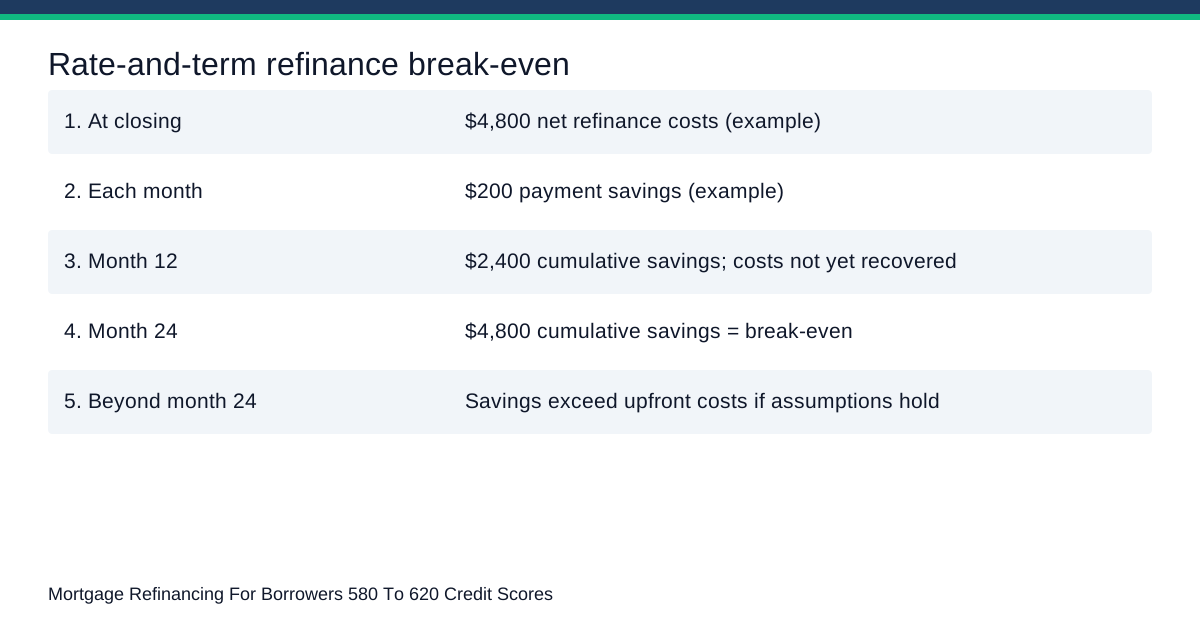
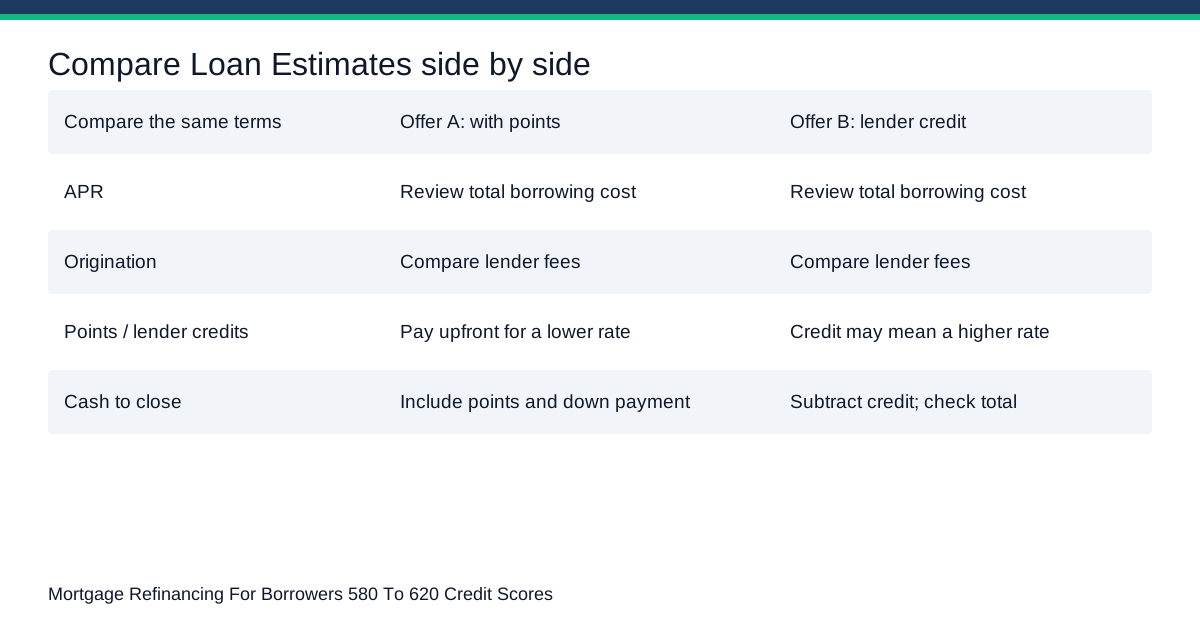
Compare Loan Estimates for the same loan type and term. Include closing costs when calculating whether refinancing saves money.
| Cost Category | Typical Range (USD) | Description |
|---|---|---|
| Upfront Mortgage Insurance Premium (UFMIP) | $1,800 - $4,500 | 1.75% of loan amount; can be financed into new loan |
| Lender Origination Fee | $0 - $2,500 | Varies by lender; some offer zero-cost options |
| Credit Report (if credit-qualifying) | $30 - $75 | Required only for credit-qualifying streamlines |
| Title Insurance | $400 - $1,200 | May be reduced or waived in some cases |
| Recording Fees | $50 - $250 | County-dependent; generally lower for streamlines |
| Flood Certification | $15 - $25 | Required to verify flood zone status |
| Third-Party Service Fees | $200 - $600 | Includes document prep, wire fees, etc. |
| Total Estimated Costs | $2,495 - $9,150 | Depending on loan amount and lender |
Many borrowers with credit scores between 580 and 620 choose to finance these costs into the new loan amount rather than paying them out of pocket. This "no-cash-out" refinance option is specifically permitted under FHA Streamline rules, making the program accessible even to those without significant savings.
The Credit-Qualifying vs. Non-Credit-Qualifying Decision
Non-Credit-Qualifying Streamline
For borrowers in the 580-620 credit score range, the non-credit-qualifying option typically presents the path of least resistance. This version:
- Requires no credit report or credit score verification
- Eliminates employment verification in most cases
- Does not require income documentation
- Focuses exclusively on mortgage payment history
- Processes faster due to reduced documentation
Credit-Qualifying Streamline
Some borrowers opt for the credit-qualifying version despite scores in the 580-620 range because it offers:
- Slightly more flexibility in calculating debt-to-income ratios for complex situations
- Ability to add or remove borrowers from the loan
- Potential for better interest rates with some lenders
- Option to finance larger closing costs in certain situations
Step-by-Step Process to Complete Your FHA Streamline Refinance
Successfully navigating the FHA Streamline refinance process requires understanding each phase. Here's the complete roadmap:
- Verify Your Eligibility (Week 1)
- Shop for Lenders and Rates (Weeks 1-2)
- Submit Your Application (Week 2)
- Underwriting and Processing (Weeks 3-5)
- Closing (Week 5-6)
- Post-Closing (Ongoing)
The entire process typically takes 30-45 days from application to closing, though some lenders advertise streamlined timelines as short as 21 days for non-credit-qualifying refinances.
How to Maximize Approval Odds with a Lower Credit Score
Even though FHA Streamline refinances are more forgiving than conventional loans, borrowers with credit scores between 580 and 620 can take specific steps to strengthen their applications:
Maintain Perfect Mortgage Payments: In the 12 months leading up to your application, prioritize your mortgage payment above all other debts. A spotless recent mortgage payment record can overcome a multitude of other credit challenges.
Choose the Non-Credit-Qualifying Option: Unless you have specific reasons to pursue credit-qualifying (like adding a co-borrower), the non-credit-qualifying route eliminates credit score as a factor entirely.
Document Special Circumstances: If your credit score dropped due to medical issues, divorce, or other one-time events rather than chronic financial mismanagement, providing context can help with lenders who consider these factors.
Work with FHA-Specialized Lenders: Not all mortgage lenders have equal expertise with FHA Streamline refinances. Seek out lenders who specifically advertise their work with credit-challenged borrowers and have dedicated FHA departments.
Time Your Application Strategically: If you're approaching the 12-month mark since a late payment, waiting a few extra weeks to apply can make your payment history look significantly stronger.
Reduce Your Debt-to-Income Ratio: Even for non-credit-qualifying streamlines, some lenders perform informal debt checks. Paying down credit cards or other debts can create a stronger overall financial profile.
Common Misconceptions About FHA Streamline Requirements for Low Credit Borrowers
Many qualified borrowers with credit scores in the 580-620 range avoid exploring FHA Streamline refinancing due to widespread misconceptions:
Myth: You need good credit to refinance an FHA loan. Reality: The non-credit-qualifying Streamline option requires no credit check whatsoever, and even credit-qualifying versions accept scores as low as 580 with most lenders.
Myth: Closing costs make refinancing too expensive for small payment reductions. Reality: The ability to finance closing costs into your loan amount, combined with competitive FHA rates, often means positive cash flow from month one even with financed costs.
Myth: If your home has decreased in value, you can't refinance. Reality: FHA Streamline refinances require no appraisal, so current home value is irrelevant. You can refinance even if you're underwater on your mortgage.
Myth: The process is complicated and time-consuming. Reality: FHA Streamlines are specifically designed to be simpler than traditional refinances, with significantly less documentation and faster timelines.
Myth: You need substantial equity in your home. Reality: No equity is required. The FHA Streamline program specifically allows refinancing of mortgages with loan-to-value ratios above 100%.
Frequently Asked Questions
Yes, particularly if you choose the non-credit-qualifying option. The FHA Streamline program focuses primarily on your FHA mortgage payment history, not your overall credit profile. As long as your FHA mortgage payments have been made on time (no more than one 30-day late payment in the past 12 months), late payments on credit cards, auto loans, or other debts typically won't disqualify you from a non-credit-qualifying Streamline refinance.
How much can I lower my monthly payment with an FHA Streamline Refinance if I have a 620 credit score?
The payment reduction depends on the difference between your current interest rate and available market rates, not your credit score. In 2026, borrowers are seeing monthly payment reductions ranging from $150 to $400+ on typical loan balances of $250,000-$350,000 when refinancing from rates of 6.5-7.5% down to current FHA rates. Remember that for fixed-to-fixed refinances, the FHA requires at least a 5% reduction in your principal and interest payment to meet the net tangible benefit requirement.
Do I need an appraisal for FHA Streamline Refinance with bad credit in the 580-620 range?
No appraisal is required for any FHA Streamline Refinance, regardless of your credit score. This is one of the program's greatest advantages, especially for borrowers whose homes may have declined in value or who live in areas with challenging appraisal conditions. The elimination of the appraisal requirement also reduces costs and speeds up the refinancing timeline considerably.
What if I'm currently on a forbearance or loan modification—can I still qualify for an FHA Streamline?
If you're currently in an active forbearance, you'll need to complete the forbearance period and establish a payment history on your modified terms before qualifying for a Streamline refinance. Typically, lenders require 3-6 months of on-time payments after exiting forbearance before they'll process a Streamline application. However, if you successfully completed a forbearance in the past and have since re-established consistent payment history, that previous forbearance won't necessarily disqualify you.
Can I use an FHA Streamline Refinance to remove mortgage insurance if I have a credit score under 620?
FHA Streamline Refinances cannot remove FHA mortgage insurance, as all FHA loans include both upfront and annual mortgage insurance premiums regardless of equity levels. However, if your current FHA loan originated before June 2013, your existing loan might have mortgage insurance that can be cancelled after reaching 78% loan-to-value through regular payments. In this case, you'd need to carefully calculate whether a Streamline refinance makes sense, as your new loan would include permanent mortgage insurance under current FHA rules. Consult with a loan officer to run specific numbers for your situation.
Take the Next Step Toward Lower Monthly Payments
The FHA Streamline Refinance Requirements for Low Credit Borrowers create a legitimate opportunity to reduce your housing costs even if your credit score falls between 580 and 620. Unlike conventional refinancing programs that place heavy emphasis on credit scores, the FHA Streamline program recognizes that your mortgage payment history tells the most important story about your reliability as a borrower.
With interest rates and programs constantly evolving, the right time to explore your options is now. Our network of FHA-specialized lenders understands the unique challenges faced by borrowers with credit scores in the 580-620 range and can provide personalized guidance on whether an FHA Streamline Refinance makes financial sense for your specific situation.
Request your free, no-obligation refinance consultation today. Within 24 hours, you'll receive a customized analysis showing your potential monthly savings, estimated closing costs, and break-even timeline. There's no credit check required to receive your preliminary quote, and our participating lenders specialize in helping borrowers with credit challenges access the FHA Streamline program. Don't let your credit score prevent you from exploring thousands of dollars in potential savings—discover what you qualify for right now.
Frequently Asked Questions
What is the minimum credit score for an FHA Streamline refinance?
The FHA Streamline refinance program does not require a minimum credit score for non-credit-qualifying refinances. For credit-qualifying options, lenders may have their own standards, but the program is designed to be accessible to borrowers with lower credit scores, including those in the 580-620 range.
Do I need an appraisal for an FHA Streamline refinance?
No, an appraisal is typically not required for an FHA Streamline refinance. The program is designed to minimize documentation, and the value of your home is generally not a factor as long as you are not seeking cash out.
How long do I need to have my current FHA loan before refinancing?
You must have made at least six monthly payments on your current FHA loan, and the loan must have been endorsed at least 210 days before the new loan application. Additionally, at least 210 days must have passed since your first payment due date.
What is a net tangible benefit in an FHA Streamline refinance?
A net tangible benefit means the refinance must result in a measurable improvement for the borrower, such as a lower monthly payment, a lower interest rate, or a change from an adjustable-rate to a fixed-rate mortgage. This requirement protects borrowers from refinancing without gaining a real advantage.
Key Takeaways
- Understanding your options for fha streamline refinance requirements for low credit borrowers is the first step
- Getting pre-qualified helps you understand your real options