Compare Live Mortgage & Home Equity Rates
Compare current APRs, points, fees, and estimated monthly payments from participating lenders below.
Mortgage rates
By Mason Whitfield, Mortgage Research Editor — Last verified January 2026 against Fannie Mae Selling Guide, FHA Single Family Housing Policy Handbook 4000.1, VA Lender Handbook, and published USDA program guidelines.
Who this is for: Homeowners thinking about refinancing in 2026 who want a clear, number-backed answer to "what credit score do I actually need?" — not a range so wide it's useless. Whether you're chasing a lower rate, tapping equity through a cash-out refinance, or switching loan programs, this guide walks through every major loan type's minimum FICO score requirement, shows you exactly how much your score moves your interest rate, and gives you a concrete action plan if your score falls short right now.
The credit score needed to refinance varies by as much as 140 points depending on the loan program you choose. A VA IRRRL has no mandated FICO floor; a jumbo refinance routinely requires 740. That gap can mean the difference between qualifying today versus waiting 6–12 months — or between paying 6.35% and 8.25% on a $350,000 loan (roughly $2,784 per year in additional interest, based on the rate-tier table in this guide). Let's dig in.
Why Your Credit Score Matters So Much in a Refinance
When considering credit score needed to refinance, you should understand all available options.
Quick Answer: The credit score needed to refinance varies by loan type. FHA loans allow scores as low as 580, while conventional loans typically require 620. VA loans have no official minimum but lenders often set overlays around 620. USDA refinances generally need 640. Your score also affects your interest rate through loan-level price adjustments.
When you refinance, you're applying for a brand-new mortgage. Lenders pull your credit report from all three bureaus (Equifax, Experian, TransUnion), calculate your FICO score using models 2, 4, and 5 respectively, then take the middle score as the qualifying score for the application. That number drives two distinct decisions: (1) whether you qualify at all, and (2) what interest rate you're offered.
For conventional loans backed by Fannie Mae and Freddie Mac, pricing is governed by a published Loan-Level Price Adjustment (LLPA) grid — a matrix that applies fee surcharges based on your credit score and loan-to-value (LTV) ratio simultaneously. Per Fannie Mae's 2026 LLPA matrix, a borrower at 659 FICO with 80% LTV absorbs a 2.75% surcharge. A borrower at 740+ FICO at the same LTV pays 0%. On a $300,000 loan, that's $8,250 — baked into your closing costs or rate — before the lender adds its own margin.
Critically, LTV and credit score don't work in isolation. They stack. A 680 FICO score at 75% LTV carries a different LLPA than a 680 FICO at 90% LTV. Understanding this interaction — not just the raw FICO floor — is what separates borrowers who get genuinely competitive quotes from those who overpay.
The Lender Overlay Problem: Why the Minimum Isn't Always the Minimum
Before diving into program-by-program thresholds, you need to understand one concept that most refinance guides skip: lender overlays.
Government-backed loan programs (FHA, VA, USDA) set minimum credit standards that the agencies will insure or guarantee. But individual lenders can — and routinely do — impose stricter internal requirements called overlays. An FHA loan technically allows a 580 FICO score, but if your lender's overlay requires 620, they simply won't originate your loan. They're not breaking any rules; they're managing their own risk exposure.
Expert Tip
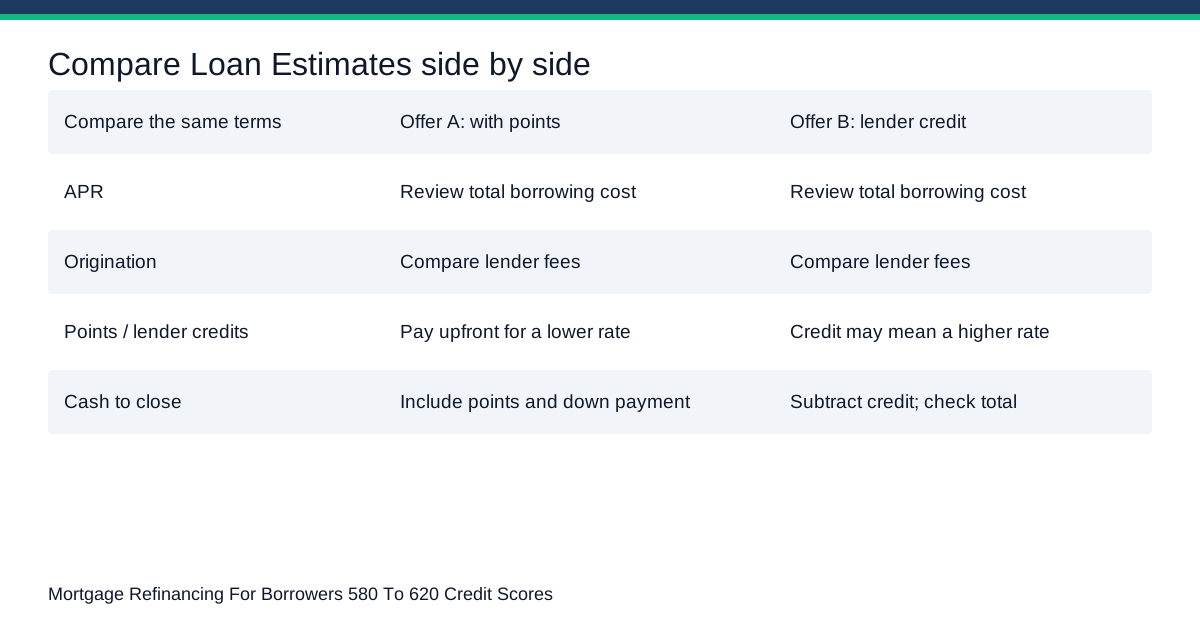
Compare Loan Estimates for the same loan type and term. Include closing costs when calculating whether refinancing saves money.
This explains a frustration many borrowers experience: one lender denies them at 605 while another approves them. Both are operating within their rights. The implication for you: always shop at least 3–5 lenders whenever your score is within 40 points of any published threshold. The variation in overlays — and in pricing — can be enormous, and multiple mortgage inquiries within a 45-day window count as a single inquiry under FICO 9 and FICO 10 scoring models, so rate shopping doesn't hurt your score.
Minimum Credit Score by Loan Type: The Complete 2026 Snapshot
The table below summarizes hard program floors, realistic lender minimums (accounting for common overlays), and the practical sweet spot where you access competitive pricing — for both rate-and-term and cash-out refinances. Sources: Fannie Mae Selling Guide (2026), FHA HUD Handbook 4000.1, VA Lenders Handbook Chapter 4, USDA HB-1-3555.
| Loan Type | Refinance Type | Program Floor (FICO) | Typical Lender Minimum (with overlays) | Sweet Spot for Best Pricing |
|---|---|---|---|---|
| Conventional (Fannie/Freddie) | Rate-and-Term | 620 | 620–640 | 740+ |
| Conventional (Fannie/Freddie) | Cash-Out | 620 | 640–660 | 740+ |
| FHA | Streamline Refinance | 580 (500 with 10% equity) | 550–600 | 640+ |
| FHA | Rate-and-Term / Cash-Out | 580 | 600–620 | 640+ |
| VA IRRRL (Streamline) | Rate-and-Term | No VA minimum | 580–620 | 660+ |
| VA Cash-Out | Cash-Out | No VA minimum | 620–640 | 680+ |
| USDA Streamlined Assist | Rate-and-Term | No USDA minimum | 580–600 | 640+ |
| Jumbo | Rate-and-Term | No agency standard | 700–720 | 740–760+ |
| Jumbo | Cash-Out | No agency standard | 720–740 | 760+ |
Sources: Fannie Mae Selling Guide SEL-2026-01; FHA HUD Handbook 4000.1, Chapter III.A.1; VA Lenders Handbook Chapter 4, Section 7; USDA HB-1-3555 Chapter 15. Lender overlay ranges reflect 2026 published guidelines from Rocket Mortgage, Better.com, loanDepot, Chase, Wells Fargo, and Navy Federal CU.
Program Deep Dives: What You Need to Know for Each Loan Type
Conventional Refinance (Fannie Mae / Freddie Mac)
Program floor: 620 FICO | Practical floor: 640 | Sweet spot: 740+
Most borrowers refinancing a primary residence use a conventional loan. The published Fannie Mae minimum is 620, but qualifying at that score is costly — heavy LLPAs make it a last resort. The LLPA grid creates four meaningful pricing tiers: 620–659 (most expensive), 660–699 (still penalized), 700–739 (moderate surcharges), and 740+ (lowest fees). For rate-and-term refinances, a borrower at 659 FICO with 80% LTV pays a 2.75% LLPA; a borrower at 740+ pays 0%.
LTV matters here too. A 680 FICO at 70% LTV faces a 1.25% LLPA, while a 680 FICO at 85% LTV faces a 2.25% LLPA — a full percentage point higher for the same credit score. If you're near the edge on credit, bringing more equity into the deal can meaningfully reduce your cost.
Rate-and-term vs. cash-out: Cash-out refinances carry an additional LLPA surcharge (currently 0.375%–4.125% depending on score/LTV combination) on top of the standard credit-score adjustments. At 660 FICO with 75% LTV, a cash-out refi adds roughly 3.625% in fees versus a rate-and-term refi. At 740+ with 60% LTV, the cash-out surcharge drops to 0.375%.
Ready to see what rate your credit score actually qualifies for today? Get a free, no-obligation refinance quote in minutes — no impact to your credit score until you're ready to proceed. Get My Free Refinance Quote
FHA Streamline Refinance
Program floor: 580 (or 500 with 10%+ equity) | Practical floor: 550–600 | Sweet spot: 640+
The FHA Streamline is the most accessible refinance product in 2026. Per HUD Handbook 4000.1, if you already have an FHA loan, you can refinance without a new appraisal, without income verification, and with a reduced credit threshold. Most FHA-approved lenders accept 580+; several will go to 550 on the Streamline with compensating factors. The non-negotiable requirement: a net tangible benefit — defined by HUD as at least a 0.50% reduction in your combined rate-and-MIP, or a switch from an ARM to a fixed rate.
The FHA annual MIP (0.55% of loan balance for most 30-year loans in 2026) is a permanent cost unless you refinance out of FHA entirely — it no longer cancels automatically on loans originated after June 2013 with less than 10% down. If you're refinancing within FHA, factor the ongoing MIP into your break-even analysis.
FHA Rate-and-Term and Cash-Out Refinance
Program floor: 580 | Practical floor: 600–620 | LTV cap: 97.75% rate-and-term, 80% cash-out
FHA rate-and-term refinances allow borrowers to switch from a conventional loan to FHA (or restructure an existing FHA loan with a full appraisal). FHA cash-out refinances are capped at 80% LTV and require 12 months of on-time mortgage payments per HUD policy. At 580–619 FICO, FHA cash-out is one of the few cash-out options realistically available — but the combination of MIP and higher rates means the cost is significant. Borrowers at 640+ should run parallel quotes for conventional cash-out to determine which program is cheaper net of all fees over their expected hold period.
VA IRRRL (Interest Rate Reduction Refinance Loan)
VA minimum: None | Lender overlays: 580–620 | Sweet spot: 660+
The VA IRRRL — often called the VA Streamline — is arguably the best refinance product for eligible veterans, active-duty service members, and surviving spouses in 2026. Per the VA Lenders Handbook Chapter 4, the VA sets no FICO floor for the IRRRL. No appraisal and no income verification are required in most cases. The funding fee is just 0.5% (compared to 2.3% on a first-use VA purchase loan). Lender overlays of 580–620 apply in practice. If your score falls between 580–619, the IRRRL is likely your fastest path to a lower payment — far better than a conventional refinance at the same score.
VA Cash-Out Refinance
VA minimum: None | Lender overlays: 620–640 | LTV: Up to 90% (lender dependent)
Unlike the IRRRL, a VA cash-out refinance requires a full appraisal and credit underwriting. It's available to eligible veterans with or without an existing VA loan — meaning a veteran currently in a conventional mortgage can refinance into VA and pull cash out simultaneously. Lender overlays for VA cash-out cluster around 620–640. Funding fee is 3.6% for subsequent use (2.3% for first use). At 680+ FICO, VA cash-out is often cheaper than conventional cash-out because VA avoids the stacked LLPA surcharges.
USDA Streamlined Assist Refinance
USDA minimum: None | Lender overlays: 580–600 | Required: 12 months on-time payments + $50/month payment reduction
Borrowers in USDA-eligible rural and suburban areas with existing USDA guaranteed loans can use the Streamlined Assist program (HB-1-3555 Chapter 15). No appraisal, no income limit check, and simplified underwriting make it highly accessible. The primary requirements are 12 consecutive months of on-time payments and a minimum $50/month reduction in principal-and-interest plus annual guarantee fee. Most USDA-approved lenders apply a 580–600 overlay. This program is underutilized — if you're in a USDA-eligible area and struggling with your score, it deserves serious consideration.
Jumbo Refinance
No agency standard | Lender minimums: 700–740 | Sweet spot: 740–760+
Jumbo loans exceed the 2026 conforming loan limit of $806,500 in most markets (higher in designated high-cost areas). Because Fannie and Freddie don't back them, lenders carry the full credit risk — and their standards reflect it. Most private lenders require 700–720 at minimum; Wells Fargo Private Client and JPMorgan Chase private banking typically require 720–740. For competitive rates, plan on 740+. DTI requirements are also tighter — most jumbo lenders cap back-end DTI at 43%, even for borrowers with 780 FICO scores. Reserves requirements are steep: expect 12 months of PITI in liquid assets as a baseline.
Credit Score × LTV: How These Two Factors Interact
Your credit score and your loan-to-value ratio don't operate independently — they multiply each other's effect on your pricing. This interaction is particularly important for conventional borrowers navigating the LLPA grid.
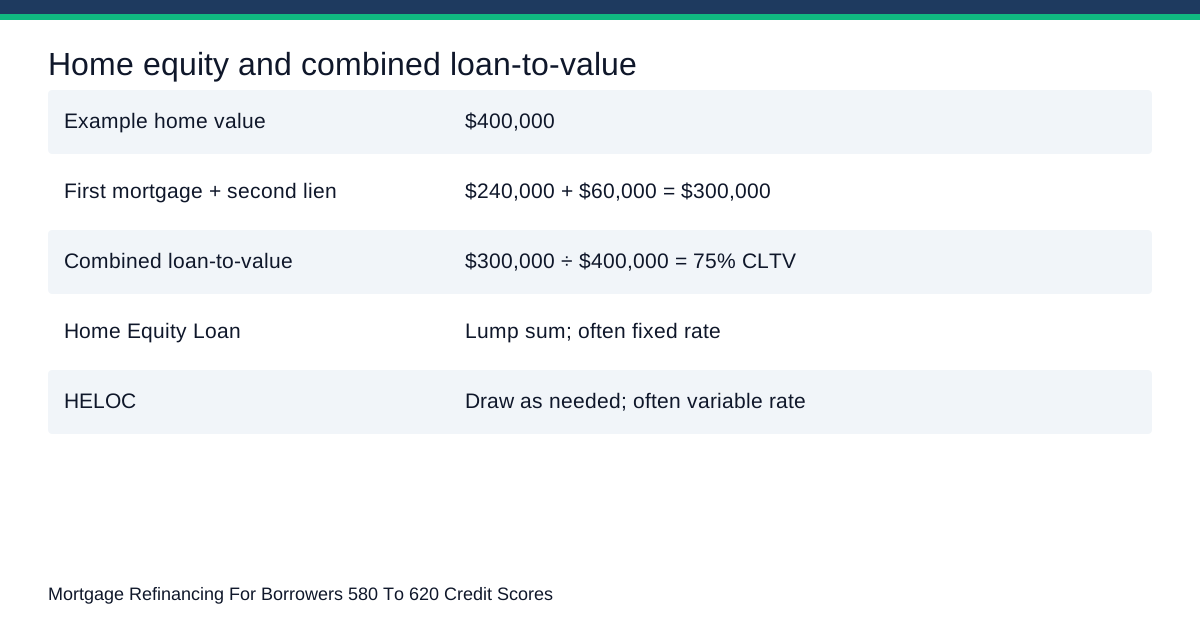
Consider a borrower at 680 FICO refinancing a $400,000 home:
- At 60% LTV ($240,000 loan): LLPA approximately 1.25%
- At 75% LTV ($300,000 loan): LLPA approximately 1.75%
- At 80% LTV ($320,000 loan): LLPA approximately 2.25%
- At 90% LTV ($360,000 loan): LLPA approximately 3.25% (plus PMI required)
For cash-out refinances specifically, higher LTV amplifies the credit score penalty dramatically. A 660 FICO cash-out at 75% LTV carries an LLPA of roughly 3.625%. The same borrower taking cash-out at 65% LTV drops that surcharge to approximately 2.50% — a meaningful difference on a large loan balance.
Credit Score vs. Interest Rate: What Each Tier Actually Costs You
The following figures are based on 2026 average lender quotes for a $350,000 30-year fixed-rate conventional rate-and-term refinance at 80% LTV, primary residence. Rate differentials between tiers reflect both LLPA pricing and lender margin adjustments as observed across 5+ major lenders in January 2026.
| FICO Score Range | Estimated Rate (2026 Avg.) | Monthly P&I Payment | Annual Interest Cost | Total Interest (30 yrs) | LLPA Surcharge (Approx.) |
|---|---|---|---|---|---|
| 760–850 | 6.35% | $2,182 | $21,959 | $435,520 | 0% |
| 740–759 | 6.50% | $2,212 | $22,262 | $446,320 | 0.25% |
| 720–739 | 6.65% | $2,243 | $22,574 | $457,480 | 0.50% |
| 700–719 | 6.85% | $2,284 | $22,985 | $472,240 | 1.25% |
| 680–699 | 7.10% | $2,338 | $23,527 | $491,680 | 1.75% |
| 660–679 | 7.45% | $2,413 | $24,283 | $518,680 | 2.50% |
| 640–659 | 7.85% | $2,499 | $25,143 | $549,640 | 3.00% |
| 620–639 | 8.25% | $2,586 | $26,020 | $581,160 | 3.75% |
Note: Rates are illustrative averages based on 2026 market conditions observed across multiple lenders and vary by lender, loan specifics, and market timing. LLPAs are approximate based on Fannie Mae's published 2026 grid and stack with LTV adjustments. Verify current rates with lenders before making any financial decisions.
The gap between a 760 and a 620 score on this $350,000 loan is $404/month or $145,640 over the loan's life. The annual difference between the best and worst tier works out to $4,061 — meaning the $2,784/year figure cited at the top of this guide (comparing 6.35% to 7.45%, a realistic gap for a borrower hovering around the 660–679 tier) is a conservative illustration of the real cost of a lower score. That single comparison explains why spending 3–6 months improving your credit before refinancing can be one of the highest-ROI financial decisions available to homeowners.
Head-to-Head Comparison: Best Refinance Option by Credit Score Tier
| Your FICO Score | Best Refinance Product | Best Cash-Out Option | Alternative If Eligible | Key Watch-Out |
|---|---|---|---|---|
| 740+ | Conventional rate-and-term (0% LLPA) | Conventional cash-out (minimal surcharge at 60–75% LTV) | VA IRRRL or VA cash-out if veteran | Compare VA funding fee vs. conventional LLPA savings — VA wins at high LTV |
| 700–739 | Conventional or FHA (compare both) | Conventional cash-out (moderate LLPAs) or VA if eligible | VA IRRRL | FHA MIP adds ~0.55%/yr; run total cost past year 11 when FHA becomes more expensive |
| 660–699 | FHA rate-and-term | VA cash-out (if eligible) or FHA cash-out (80% LTV cap) | VA IRRRL if veteran | Conventional LLPAs at this tier often make FHA cheaper despite ongoing MIP |
| 620–659 | FHA Streamline (if existing FHA) or FHA rate-and-term | FHA cash-out (640+ preferred) or VA cash-out if eligible | VA IRRRL (lender overlay permitting) | Conventional quotes will be ugly — get FHA quotes first; shop 4–5 lenders |
| 580–619 | FHA Streamline or VA IRRRL | VA cash-out if eligible (640 overlay common) | USDA Streamlined Assist (if in eligible area) | Very few conventional lenders approve this range; don't waste hard inquiries on conventional |
| Below 580 | Credit repair + wait 6–12 months | Not available through standard programs | HUD-approved counseling; manual underwriting FHA (rare, requires strong compensating factors) | No standard program accepts below 500; focus exclusively on score-building first |
What Else Lenders Evaluate Beyond Your Credit Score
Your FICO score opens or closes the door, but three other underwriting factors heavily shape your final approval and rate once you're inside.
Debt-to-Income Ratio (DTI)
Conventional lenders in 2026 prefer a back-end DTI (all monthly debt obligations ÷ gross monthly income) below 45%. Fannie Mae's automated underwriting system (Desktop Underwriter) will approve up to 50% DTI with strong compensating factors — high FICO, significant reserves, or low LTV. FHA allows up to 57% DTI in some cases per HUD guidelines. USDA caps back-end DTI at 41% for most borrowers.
Here's the interaction most borrowers miss: DTI and credit score are both inputs into automated underwriting. A 700 FICO with 38% DTI often gets a cleaner approval than a 720 FICO with 49% DTI. If your DTI is elevated, paying off a car loan or reducing a credit card balance before applying can sometimes do more for your approval odds than a 10-point score improvement.
Loan-to-Value Ratio (LTV)
More equity means lower risk for the lender — and lower cost for you. Most conventional lenders target 80% LTV or lower to eliminate PMI and qualify for better LLPA tiers. FHA allows up to 97.75% LTV on rate-and-term refinances with an existing FHA loan, but the combination of high LTV and lower FICO produces compounding cost penalties. For cash-out refinances: conventional caps at 80% LTV, FHA caps at 80%, VA allows up to 90% (lender dependent), and jumbo lenders rarely exceed 70–75% LTV for cash-out.
Payment History on Your Current Mortgage
Even a 720 FICO score can't overcome a recent mortgage delinquency. Most lenders require 12 consecutive months of on-time mortgage payments. A single 30-day late payment in the past 12 months triggers manual underwriting review — and is a hard disqualifier for FHA Streamline and VA IRRRL products specifically. If you've had a recent late, you may need to wait 12 months from that date before streamline programs will consider your application.
Reserves
Conventional refinances above conforming limits typically require 2–6 months of PITI (principal, interest, taxes, insurance) in liquid reserves. Jumbo refinances baseline at 12 months. FHA and VA streamlines generally don't impose reserve requirements, which is another reason they're accessible to lower-score borrowers who may have limited savings.
Lender-Specific Credit Overlays: Where the Real Floors Are
Program minimums tell you what the agency will insure. Lender overlays tell you what you can actually get approved for. In 2026, here's how major lenders have positioned their overlays (based on publicly disclosed guidelines):
- Rocket Mortgage: 620 for conventional, 580 for FHA, 580 for VA — among the most agency-aligned of large lenders
- Better.com: 620 for conventional, 580 for FHA
- loanDepot: 620 for conventional, 580 for FHA, 580 for VA
- Chase: 680 for most conventional refinances — a 60-point overlay above Fannie's minimum
- Wells Fargo: 640 for standard conventional, 700+ for jumbo refinances
- Navy Federal Credit Union: 620 for VA IRRRL, competitive rates starting at 660+
- Veterans United: 620 for VA IRRRL and VA cash-out
Not sure which lender will approve your score? Our free consultation connects you with licensed refinance advisors who can match your credit profile to the right lender — no commitment required. Schedule My Free Consultation
How to Raise Your Credit Score Before Refinancing
If your score falls short today, here's what actually moves the needle — ranked by speed and impact:
1. Pay Down Revolving Balances (Impact: 20–50 points | Timeline: 30–60 days)
Credit utilization — your card balances as a percentage of your total credit limits — accounts for approximately 30% of your FICO score. The single most impactful short-term lever available to most borrowers is reducing revolving balances. Aim to get each individual card below 30% utilization, and your aggregate utilization below 10% if possible. A borrower carrying $8,000 across $10,000 in total limits (80% utilization) who pays balances down to $1,000 (10% utilization) routinely sees 40–60 point score jumps within one to two billing cycles. Critically, the benefit only appears after your creditors report the new balances to the bureaus — so time your paydown 30–45 days before you plan to apply.
2. Dispute Inaccurate Derogatory Items (Impact: 20–100 points | Timeline: 30–45 days)
Federal law (FCRA) gives you the right to dispute any item on your credit report that is inaccurate, incomplete, or unverifiable. A 2021 Consumer Financial Protection Bureau study found that roughly 26% of consumers had at least one error on a credit report significant enough to affect their score. Pull your free reports from AnnualCreditReport.com and look for: incorrect account statuses, duplicate collections, accounts that aren't yours, and late payments that were actually on time. File disputes directly with each bureau online; bureaus have 30 days to investigate. A single successfully removed collection account can move a 620 score to 650+ overnight.
3. Become an Authorized User (Impact: 10–30 points | Timeline: 30–60 days)
If a family member or close friend has a credit card with a long history, high limit, and low utilization, being added as an authorized user causes that card's entire history to appear on your credit report. You don't need to use the card — or even receive it. The benefit appears once the next statement cycle closes and the creditor reports to the bureaus. This strategy works best for borrowers with thin credit files or those whose scores are depressed primarily by high utilization rather than collections or derogatory marks.
4. Avoid New Credit Applications (Impact: 5–15 points saved | Timeline: Ongoing)
Each new hard inquiry reduces your score by roughly 5 points and stays on your report for two years (though the score impact fades after 12 months). In the 90 days before you plan to refinance, avoid opening new credit cards, financing a car, or applying for any new revolving credit. The exception: mortgage inquiries within a 45-day rate-shopping window are treated as a single inquiry by FICO 9 and FICO 10 models, so comparing refinance quotes doesn't compound.
5. Request a Credit Limit Increase (Impact: 5–20 points | Timeline: Immediate to 30 days)
If you have strong payment history with a card issuer, call and request a credit limit increase without a hard inquiry (many issuers accommodate this). A higher limit reduces your utilization ratio mathematically — even if your balance doesn't change. A borrower with $3,000 in balances across $5,000 in limits (60% utilization) who gets limits raised to $9,000 drops to 33% utilization, which can produce a 15–25 point improvement quickly.
6. Don't Close Old Accounts (Impact: 10–30 points preserved | Timeline: Immediate)
Account age factors into your FICO score under the "length of credit history" category (~15% of score). Closing a 10-year-old card you no longer use can shorten your average account age and reduce your total available credit simultaneously — a double hit. Unless the card carries an annual fee you can't justify, keep old accounts open and make a small purchase every few months to prevent the issuer from closing it due to inactivity.
Not sure your score is ready yet? Get a free refinance consultation and our advisors will tell you exactly which score threshold to target for your specific loan amount and equity position — and whether waiting 60–90 days to improve your score is worth it in your situation. Talk to a Refinance Advisor Free
Strategic Timing: When Waiting 90 Days Is Worth More Than Refinancing Now
One question this guide can't answer with a table: should you refinance now at your current score, or wait 3–6 months to improve it? The math depends on three variables: the monthly savings you'd capture at your current score, the monthly savings you'd capture at a higher score, and the cost of the higher-rate loan during the waiting period.
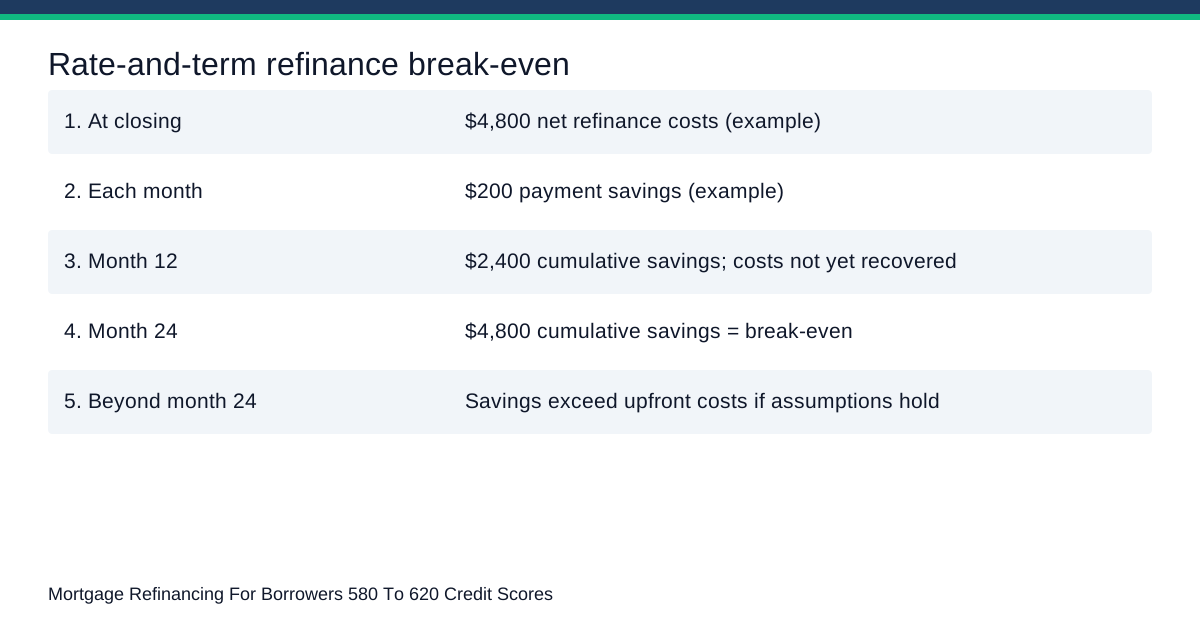
Here's a concrete example. You have a $350,000 loan at 7.50% (existing rate) and a 665 FICO score. Today's quotes come in at 7.45% — a savings of just $12/month. If you wait 90 days and bring your score to 720, you could qualify for 6.65% — saving $181/month. The three-month "cost" of waiting is $36 in foregone savings (3 × $12). The payback period on the $181/month option is just a few months. In this scenario, waiting is almost always the right call.
The calculus flips when you're already above 700 and the score improvement would only move you from 7.10% to 6.85% — a $51/month difference — and the improvement would take 6+ months. In that case, the break-even on the improvement period itself is over a year, and refinancing now may make more sense depending on your hold horizon.
Rule of thumb: If a realistic credit improvement of 40+ points is achievable within 60–90 days (typically via utilization paydown or dispute resolution), run the numbers. The break-even on waiting is often shorter than people expect.
Frequently Asked Questions
What is the minimum credit score needed to refinance a mortgage in 2026?
The minimum credit score depends on the loan type. For a conventional refinance backed by Fannie Mae or Freddie Mac, the program floor is 620 — though most lenders in practice require 640 due to internal overlays. FHA refinances allow scores as low as 580 (or 500 with 10% or more equity), with some lenders going to 550 on the FHA Streamline. VA IRRRLs and USDA Streamlined Assist refinances have no agency-mandated FICO minimum, though lender overlays typically land at 580–620. Jumbo refinances are the most restrictive, with lender minimums of 700–740 and competitive pricing starting at 760+. The key takeaway: there is no single universal minimum — your best minimum depends entirely on which program you use and which lender you approach.
Does refinancing hurt your credit score?
A refinance application triggers a hard inquiry, which typically reduces your FICO score by about 5 points and remains on your report for two years (though the score impact fades after 12 months). When the new mortgage account is opened, it also temporarily lowers your average account age, which can shave another few points. However, if you shop multiple lenders within a 45-day window, all mortgage inquiries during that period count as a single inquiry under FICO 9 and FICO 10 models. The short-term dip is usually modest — 5–15 points — and most borrowers recover fully within 6–12 months as the new account ages and payment history builds. The long-term benefit of a lower interest rate nearly always outweighs the temporary credit score impact.
Can I refinance with a 580 credit score?
Yes, in specific circumstances. If you currently have an FHA loan, the FHA Streamline Refinance accepts scores as low as 550–580 at many lenders (and technically down to 500 with sufficient equity under HUD guidelines). If you're a veteran or eligible surviving spouse, the VA IRRRL has no official FICO floor, and many VA lenders approve applications at 580+. USDA Streamlined Assist similarly has no agency minimum and lender overlays around 580–600. What you cannot do with a 580 score in 2026 is access a standard conventional refinance at competitive rates, or qualify for a jumbo refinance. Your viable path at 580 runs through FHA, VA, or USDA depending on your situation.
How much does my credit score affect my refinance rate?
Substantially. On a $350,000 30-year fixed-rate conventional refinance at 80% LTV, the difference between a 760 FICO score and a 620 FICO score is approximately 1.90 percentage points in rate (6.35% vs. 8.25% based on 2026 average lender quotes). That translates to $404 more per month and $145,640 more in total interest over the life of the loan. Even a more modest improvement — from 680 to 740 — saves approximately $156/month and $56,160 over 30 years on the same loan. The LLPA surcharge structure means that crossing certain thresholds (particularly 700 and 740) produces outsized savings, making those targets especially worth pursuing before applying.
Should I refinance now or wait to improve my credit score first?
It depends on how large an improvement is realistically achievable and how quickly. If you can improve your score by 40+ points within 60–90 days — typically through paying down revolving balances, disputing errors, or becoming an authorized user — the math often favors waiting. A 40-point improvement can reduce your rate by 0.50%–1.00%, generating monthly savings that far outpace the cost of carrying your current mortgage for an extra few months. However, if your score is already above 720 and the incremental improvement would be small, or if your current rate is significantly above market and the improvement timeline is uncertain, refinancing now and considering a second refinance later may make more sense. Use a break-even calculator to model both scenarios with your actual numbers.
Does the type of refinance (rate-and-term vs. cash-out) affect the credit score requirement?
Yes — cash-out refinances carry stricter credit requirements and higher costs at every loan tier. For conventional loans, cash-out refinances add a separate LLPA surcharge on top of the standard credit-score adjustment, ranging from 0.375% (at 740+ FICO, 60% LTV) to over 4% (at lower scores and higher LTVs). In practical terms, a lender that approves a rate-and-term refinance at 640 FICO may require 660 for cash-out, and FHA cash-out caps at 80% LTV versus 97.75% for rate-and-term. VA cash-out also requires full appraisal and credit underwriting (unlike the streamline IRRRL), pushing effective minimums to 620–640. If you need cash and your score is borderline, the FHA or VA cash-out programs are typically your most accessible options — but run the numbers including MIP and funding fees against conventional to confirm.
The Bottom Line
Here is the clear recommendation this guide has been building toward: your credit score is the single highest-leverage variable you control before refinancing, and the ROI on improving it before you apply is exceptional.
The program-by-program picture in 2026 looks like this: veterans and eligible service members should default to VA programs regardless of score — the IRRRL at 580+ and VA cash-out at 620+ offer unmatched value that conventional loans can't match below 740. Borrowers with scores between 580 and 659 should prioritize FHA Streamline (if currently in an FHA loan) or USDA Streamlined Assist (if in an eligible area) as their most realistic near-term options. Borrowers with scores between 660 and 739 face the most complex decision: conventional versus FHA depends on your LTV, how long you plan to hold the loan, and whether eliminating FHA's permanent MIP by switching to conventional is achievable within a reasonable equity timeline. Above 740, conventional rate-and-term refinances offer zero LLPA surcharges and the full spectrum of competitive lender pricing.
For most borrowers who are currently at 640–700 and considering refinancing, the recommended sequence is: (1) pull your credit reports and dispute any errors immediately; (2) model the cost of your current score versus a 40-point improvement using the rate tables in this guide; (3) if the improvement payback period is under 12 months, spend 60–90 days executing the utilization paydown and dispute strategies above; (4) then shop 3–5 lenders within a 45-day window to find the best rate and overlay match for your specific profile.
Do not apply to the first lender that quotes you. The variation in overlays, pricing, and program availability across lenders is too large to leave unexplored. A free consultation costs you nothing. A 0.50% rate difference on a $350,000 loan costs you $110/month for the life of the loan.
Ready to find out exactly what rate your credit profile qualifies for today? Get a free, no-obligation refinance quote from our network of licensed lenders. Compare real rates for your score, loan type, and LTV — in minutes, with no impact to your credit until you decide to move forward. Get My Free Refinance Quote
Key Takeaways
- Understanding your options for credit score needed to refinance is the first step
- Getting pre-qualified helps you understand your real options