Compare Live Mortgage & Home Equity Rates
Compare current APRs, points, fees, and estimated monthly payments from participating lenders below.
Mortgage rates
Conventional vs FHA Refinance for 580 to 620 Credit Scores: Your Complete Guide
Quick Answer: For borrowers with credit scores between 580 and 620, FHA refinancing is generally more accessible than conventional refinancing. FHA loans accept scores as low as 580, while conventional loans typically require a minimum of 620. However, some conventional programs may be available with compensating factors like substantial equity. Your choice depends on your current loan type, equity, and financial goals.
If you're considering a mortgage refinance with a credit score between 580 and 620, understanding your options is crucial. The debate between Conventional vs FHA Refinance for 580 to 620 Credit Scores comes down to a few key factors: your current loan type, available equity, upfront costs, and long-term monthly payment goals. While FHA refinance programs are specifically designed for borrowers with lower credit scores and can accept scores as low as 580 for streamline refinances, conventional refinancing typically requires higher credit scores and may not be accessible until you reach at least 620. However, certain conventional programs do exist for borrowers in this credit range, often with compensating factors like substantial equity or lower debt-to-income ratios. This guide will help you determine which refinance path makes the most financial sense for your situation.
Understanding Your Credit Score Position in Today's Refinance Market
Credit scores between 580 and 620 place you in what lenders call the "subprime" to "near-prime" category. This range presents unique challenges and opportunities in the refinance market as of 2026.
With a 580-620 credit score, you're above the minimum threshold for FHA refinancing but below the typical conventional lending standards. Most conventional lenders set their minimum credit score requirement at 620, though some portfolio lenders and credit unions may work with scores as low as 580 with significant compensating factors.
The Impact of Your Credit Score on Refinance Rates
Your credit score directly affects your interest rate. Borrowers in the 580-620 range typically pay 1.5% to 3.0% higher interest rates compared to those with scores above 740. For a $250,000 refinance, this translates to an additional $250 to $500 in monthly payments.
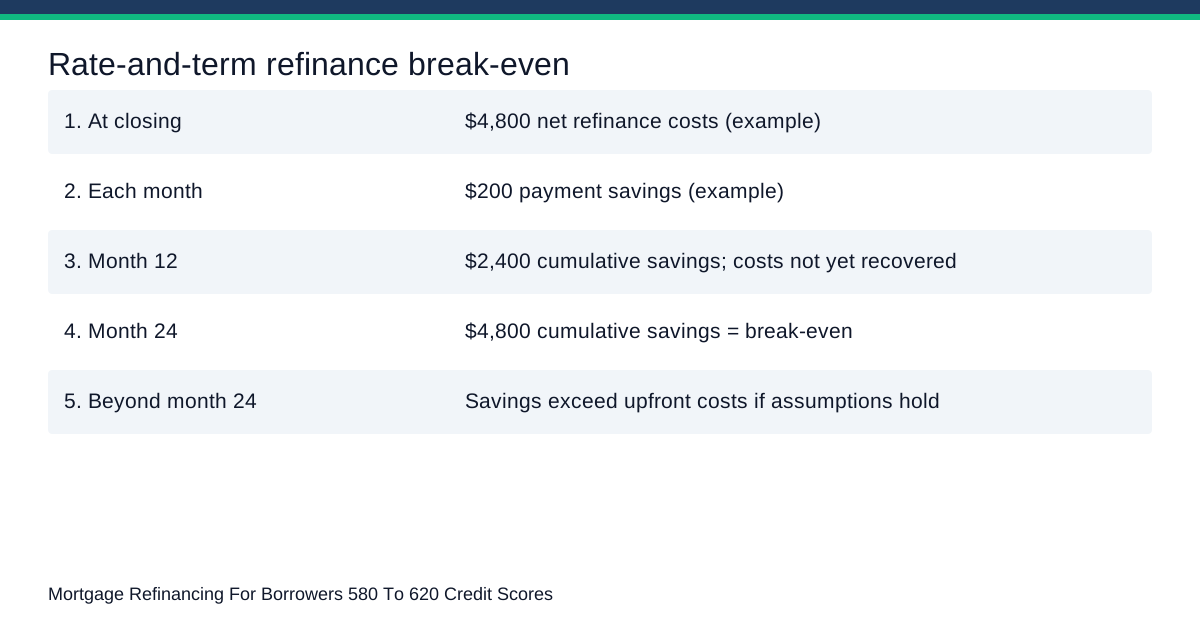
Understanding this cost difference is essential when evaluating whether refinancing makes sense. You'll need to calculate your break-even point—the time it takes for monthly savings to exceed upfront costs—with realistic rate expectations for your credit tier.
FHA Refinance Options for 580-620 Credit Scores
The Federal Housing Administration offers two primary refinance programs for borrowers with credit scores in this range: the FHA Streamline Refinance and the FHA Cash-Out Refinance.
FHA Streamline Refinance
The FHA Streamline Refinance is the most accessible option for borrowers who currently have an FHA loan. This program requires:
- Minimum credit score of 580 (some lenders may require 600)
- Current FHA mortgage in good standing
- No cash-out (limited to $500)
- Net tangible benefit to the borrower
- No home appraisal in most cases
- No income verification for most applicants
FHA Cash-Out Refinance
If you need to access your home's equity or currently have a conventional loan, the FHA Cash-Out Refinance might be appropriate. Requirements include:
Expert Tip
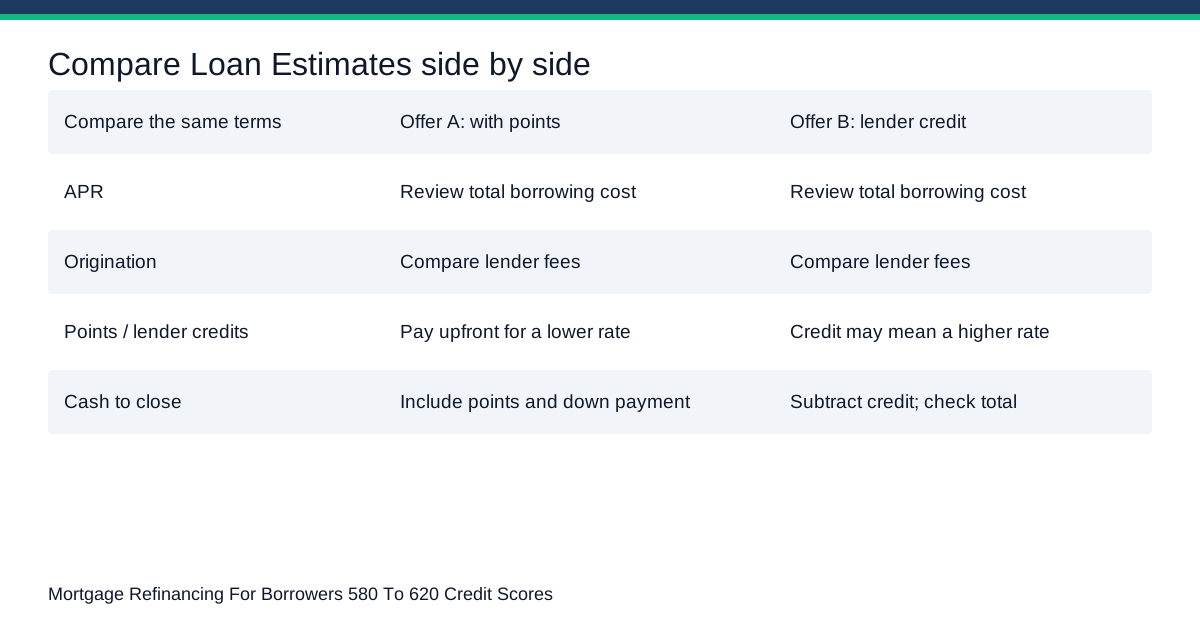
Compare Loan Estimates for the same loan type and term. Include closing costs when calculating whether refinancing saves money.
- Minimum credit score of 580 (though most lenders require 600)
- Maximum loan-to-value ratio of 80%
- Full income and employment documentation
- Complete home appraisal required
- Occupancy requirement (primary residence)
- Six-month waiting period from original purchase
FHA Mortgage Insurance Considerations
A critical factor in the Conventional vs FHA Refinance for 580 to 620 Credit Scores decision is mortgage insurance. FHA loans require both upfront and annual mortgage insurance premiums:
- Upfront Mortgage Insurance Premium (UFMIP): 1.75% of the loan amount
- Annual Mortgage Insurance Premium (MIP): 0.55% to 1.05% of the loan amount, divided into monthly payments
Conventional Refinance Possibilities for Your Credit Range
While conventional refinancing is more challenging with a 580-620 credit score, it's not impossible in all cases.
Conventional Refinance at 620 Credit Score
Once you reach a 620 credit score, conventional refinancing becomes available through many lenders. You'll face higher interest rates and stricter requirements than prime borrowers, but you gain several advantages over FHA:
- No upfront mortgage insurance premium
- Ability to cancel PMI once you reach 20% equity
- Generally lower annual mortgage insurance costs
- More flexibility in property types and loan amounts
Compensating Factors That Help
Lenders may approve conventional refinances for borrowers at the lower end of this credit range with strong compensating factors:
- Significant home equity (30% or more)
- Low debt-to-income ratio (below 36%)
- Substantial cash reserves (six months or more)
- Consistent employment history (two years or longer)
- Recent credit score improvement trend
Credit Union and Portfolio Lender Options
Some credit unions and portfolio lenders (institutions that keep loans on their own books rather than selling them) offer conventional refinance products for borrowers below 620. These programs typically feature:
- Minimum credit scores of 580-600
- Higher interest rates (0.5% to 1.5% above standard conventional rates)
- Relationship requirements (existing accounts, direct deposit)
- Lower maximum loan amounts
- Additional documentation requirements
Cost Comparison: FHA vs Conventional Refinance
Here's a detailed comparison of what you can expect to pay with each refinance type for a $250,000 loan amount:
| Cost Factor | FHA Streamline | FHA Cash-Out | Conventional (620+) |
|---|---|---|---|
| Upfront Costs | |||
| Appraisal Fee | $0 (often waived) | $450-$650 | $450-$650 |
| Credit Report | $35-$75 | $35-$75 | $35-$75 |
| Origination Fee | $0-$1,500 | $1,000-$2,500 | $1,000-$2,500 |
| Title & Escrow | $1,200-$2,000 | $1,500-$2,500 | $1,500-$2,500 |
| Upfront MI Premium | $4,375 (1.75%) | $4,375 (1.75%) | $0 |
| Total Closing Costs | $2,500-$5,000 | $4,000-$8,000 | $3,500-$6,500 |
| Monthly Costs | |||
| Interest Rate (est.) | 6.75%-7.25% | 7.00%-7.75% | 6.50%-7.50% |
| Monthly MI | $115-$220 | $115-$220 | $100-$200 |
| MI Duration | Life of loan | Life of loan | Until 20% equity |
Rates and costs estimated for borrowers with 580-620 credit scores as of 2026. Actual costs vary by lender, credit profile, and market conditions.
Step-by-Step Process to Refinance with a 580-620 Credit Score
Follow this proven process to maximize your chances of approval and secure the best possible terms:
- Check all three credit reports (Experian, Equifax, TransUnion) and dispute any errors. Even small improvements in your score can significantly impact your rate and options.
- Calculate your home equity position by obtaining a preliminary home value estimate and comparing it to your current mortgage balance. You'll need at least 20% equity for conventional refinancing and can work with up to 97% LTV for FHA streamline.
- Gather required documentation including recent pay stubs (two months), W-2 forms (two years), tax returns (two years), bank statements (two months), and your current mortgage statement.
- Request rate quotes from multiple lenders including traditional banks, credit unions, and online mortgage lenders. Ensure you're comparing the same loan type and terms across all quotes.
- Apply with your top 2-3 lender choices within a 14-day window to minimize credit score impact. Multiple mortgage inquiries within this timeframe count as a single inquiry.
- Review Loan Estimates carefully when they arrive within three business days of application. Compare interest rates, annual percentage rates (APR), closing costs, and monthly payment amounts.
- Lock your interest rate once you've selected a lender and are confident rates won't drop significantly. Rate locks typically last 30-60 days and protect you from rate increases during processing.
- Complete underwriting requirements promptly by responding quickly to any lender requests for additional documentation or clarification.
- Schedule your closing once you receive clear-to-close status, and review your Closing Disclosure at least three days before the closing date.
- Close on your new loan by signing final documents and providing any required funds. Your previous loan will be paid off, and your new loan terms take effect.
When to Choose FHA vs Conventional Refinancing
The Conventional vs FHA Refinance for 580 to 620 Credit Scores decision should be based on your specific circumstances.
Choose FHA Refinancing If:
- You currently have an FHA loan and qualify for a streamline refinance
- Your credit score is below 620
- You have less than 20% equity in your home
- You need to access equity through a cash-out refinance
- You can't meet conventional lending compensating factor requirements
- Your debt-to-income ratio is above 43%
Choose Conventional Refinancing If:
- Your credit score has reached 620 or higher
- You have at least 20% equity (or will after refinancing)
- You want to eliminate FHA mortgage insurance
- You currently have an FHA loan and want to remove lifetime MIP
- You qualify with strong compensating factors despite a lower score
- Your loan amount exceeds FHA limits in your area
The Credit Improvement Strategy
Sometimes the best answer is "neither—yet." If you're at 580-600 and can improve your credit to 620+ within 3-6 months, the benefits often outweigh the wait:
- Interest rate savings of 0.5% to 1.0%
- Access to conventional loan options
- Better loan terms and lower fees
- Increased likelihood of approval
Avoiding Common Refinance Mistakes in Your Credit Range
Borrowers with 580-620 credit scores face unique pitfalls that can derail the refinance process or result in unfavorable terms.
Mistake #1: Not Shopping Multiple Lenders
Rate and fee variations for borrowers in this credit range can be dramatic. One lender might quote 7.5% while another offers 6.75% for the identical scenario. The difference on a $250,000 loan is approximately $110 per month or $39,600 over 30 years.
Mistake #2: Ignoring Total Cost vs Monthly Payment
Some lenders will emphasize low monthly payments while hiding costs in higher interest rates or fees rolled into the loan. Always compare the APR and total interest paid over the loan term, not just the monthly payment.
Mistake #3: Refinancing Too Frequently
Each refinance resets your loan term and involves closing costs. Refinancing multiple times within a few years can cost more than you save, especially when you're paying higher rates due to your credit score.
Mistake #4: Taking Cash Out Without a Solid Plan
While accessing equity can be tempting, cash-out refinancing increases your loan balance, extends your payoff timeline, and typically carries higher rates. Only take cash out for necessary expenses or investments that provide greater returns than your interest cost.
Mistake #5: Neglecting the Break-Even Analysis
Calculate how many months you need to recoup your closing costs through monthly savings. If your break-even point is 48 months but you plan to move in 36 months, refinancing will cost you money rather than save it.
Frequently Asked Questions
A: Yes, but your options are limited. You can pursue an FHA cash-out refinance with a 580 credit score, though most lenders require 600 minimum. You'll need to meet all FHA requirements including maximum 80% loan-to-value ratio, full documentation, and appraisal. Conventional refinancing is generally not available until you reach 620, though some credit unions may work with you at 600 with strong compensating factors.
Q: How much can I save by waiting until my credit score reaches 640 before refinancing?
A: The savings can be significant. Borrowers with 640 credit scores typically receive interest rates 0.75% to 1.25% lower than those with 580-600 scores. On a $250,000 loan, this translates to $125 to $220 in monthly savings, or $45,000 to $79,200 over the life of a 30-year loan. However, you must balance this against the time value of savings—if current rates are rising or you're paying a very high rate now, waiting might cost more than it saves.
Q: Will refinancing hurt my credit score even more?
A: Refinancing typically causes a temporary credit score decrease of 5-15 points due to the hard inquiry and new account. However, your score usually recovers within 3-6 months. The bigger concern is if you're at 618-620 and an inquiry drops you below 620—wait until you have a 10-15 point buffer above key thresholds before applying.
Q: Should I pay points to lower my interest rate when refinancing with a 590 credit score?
A: Paying discount points (1% of loan amount to reduce your rate by approximately 0.25%) makes sense only if you'll stay in the home long enough to recoup the cost. For borrowers in the 580-620 credit range, focus first on improving your credit score and refinancing again in 1-2 years when you qualify for better base rates. Paying $2,500 in points now to reduce your rate from 7.25% to 7.00% provides less benefit than improving your score to 680 and refinancing to 6.00% later.
Q: Can I remove FHA mortgage insurance if I refinance my FHA loan with another FHA loan?
A: No. FHA streamline and cash-out refinances still require the full FHA mortgage insurance (both upfront and annual premiums). The only way to eliminate FHA mortgage insurance is to refinance into a conventional loan once you have sufficient equity (typically 20%) and meet conventional credit requirements. This is why many borrowers with improving credit scores plan a two-step strategy: FHA refinance now to lower their rate, then conventional refinance in 1-2 years to eliminate mortgage insurance.
Take the Next Step Toward Your Refinance
Understanding the Conventional vs FHA Refinance for 580 to 620 Credit Scores decision is just the beginning. Every borrower's situation is unique, with specific credit histories, equity positions, income documentation, and financial goals that affect which refinance path makes the most sense.
The refinance market changes constantly, with rate fluctuations, program adjustments, and new lender offerings emerging regularly. What wasn't available six months ago might be the perfect solution for your situation today.
Ready to explore your refinance options? Our team specializes in helping borrowers with credit scores in the 580-620 range find the right refinance solution. We work with multiple lenders offering both FHA and conventional programs, ensuring you get competitive quotes tailored to your credit profile.
Request your free, no-obligation refinance consultation today. We'll review your complete financial picture, explain your realistic options, provide accurate rate quotes, and help you decide whether refinancing makes sense for your goals. There's no pressure, no commitment—just honest guidance from experienced mortgage professionals who understand the challenges and opportunities in your credit range.
Get your free refinance analysis now and discover how much you could save each month while building your path to better credit and lower rates in the future.
Frequently Asked Questions
What credit score is needed for an FHA refinance?
FHA refinance programs generally require a minimum credit score of 580 for streamline refinances and cash-out refinances, though some lenders may set their minimum at 600. This makes FHA loans more accessible for borrowers with scores between 580 and 620 compared to conventional loans.
Can I refinance a conventional loan into an FHA loan with a 590 credit score?
Yes, you can refinance a conventional loan into an FHA loan with a credit score of 590, provided you meet other FHA requirements such as a maximum loan-to-value ratio of 80% for cash-out refinances and occupancy as your primary residence. Full documentation of income and employment is typically required.
What are the main differences between FHA and conventional refinance for low credit scores?
FHA refinancing is more lenient with credit scores, accepting scores as low as 580, while conventional refinancing usually requires at least 620. FHA loans also have lower down payment requirements but include upfront mortgage insurance premiums. Conventional loans may offer better rates for higher scores but are harder to qualify for in the 580-620 range.
How does my credit score affect refinance interest rates?
Your credit score directly impacts your interest rate. Borrowers with scores between 580 and 620 typically pay 1.5% to 3.0% higher rates compared to those with scores above 740. For a $250,000 loan, this could mean an additional $250 to $500 per month in payments. It's important to calculate your break-even point with realistic rate expectations.
Key Takeaways
- Understanding your options for conventional vs fha refinance for 580 to 620 credit scores is the first step
- Getting pre-qualified helps you understand your real options